NYC Ballet’s Amar Ramasar on Alexei Ratmansky’s PICTURES AT AN EXHIBITION – YouTube.
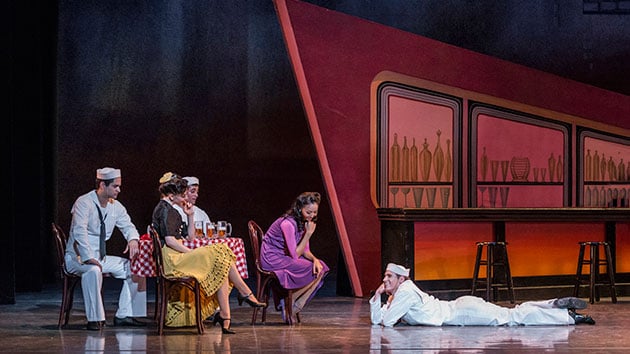
Fancy Free, whose company premiere Friday highlighted Ballet San Jose Silicon Valley’s first repertory series, would seem a natural for the troupe. Now a close ally of American Ballet Theatre, its artistic director, stellar ABT alum Jose Manuel Carreno, was known for his macho participation in Jerome Robbins’ classic romp about three sailors on shore leave, the bones of which were to lead to the smash musical On the Town, now in Broadway revival, and thence, via Gene Kelly and Frank Sinatra, to the movie version and immortality.
Fancy Free, created when Robbins was still dancing with Ballet Theater, remains one of his greatest works, also paving the way for landmarks by its young and brilliant composer, Leonard Bernstein.
So entertaining, debonair and practically perfect was Friday’s performance that what it took to get it on its feet might well be left in the dust. That would be a shame. Robbins, for all his genius, was never a fancy-free choreographer, and without the precision he dictated, from inception through its passage from Ballet Theater, as the company wasthen called, down to the present, when it remains a staple of the New York City Ballet, ABT, and dozens of fortunate troupes around the world, Fancy Free would be oh, less than nothing.So entertaining, debonair, and practically perfect was Friday’s performance that what it took to get it on its feet might well be left in the dust.
But, like most great choreographers, Robbins left orders in place to guarantee that his work would be staged the way he wanted it staged. We also see this, of course, in the work of George Balanchine and Twyla Tharp among many others; both of them were also represented Friday in Theme and Variations, a BSJ standard, and In the Upper Room, which joined the rep last year.
The way staging happens is in part through the sharing of dancers’ physical and performance recollections – dance being very much a “body to body” art form, as Edward Villella says – as well as film and notation (and pointed remarks) directly from the creator. So the stagers for these three ballets, designated by the respective artists and their trusts, worked with Ballet San Jose’s dancers to make everything the way it ought to be. They were (Fancy Free) Philip Neal, who danced for Robbins when he was co-ballet master-in-chief (whew) at the New York City Ballet; (Theme and Variations)Sandra Jennings and Stacy Caddell for the George Balanchine Trust, also at City Ballet, and (In the Upper Room) two former Tharp dancers, the great Shelley Washington, and Gil Boggs (now Colorado Ballet’s artistic director).
Of the three, Fancy Free was the standout, rising way above the tinny, taped music (Ballet San Jose, still woefully short of funds, could not reach an agreement for the services of Symphony Silicon Valley). Richly nostalgic with its angular Oliver Smith bar-room set design and Bernstein’s score, its keen rhythms evoking his fascination at the time with things Latin, plus the entire notion of carpe diem or, dare we say, dame – it was, after all, shore leave in the middle of World War II; everything, particularly the rhumbas, the moments of boyish brooding, the fights, the flirts, the resilience, the friskiness of the chase, all of it came together at the San Jose Center for the Performing Arts so precisely, with fine technique and such wonderful, readable nuance.
In the small cast, the great performances abounded: Rudy Candia, Walter Garcia and Joshua Seibel as the gobs; Grace-Anne Powers and Ommi Pipit-Suksun as their leggy quarry, and, in smaller roles, Emma Francis as a last-minute distraction, and James Kopecky as the long-suffering bartender.
Theme and Variations, all satin, tutus, Tchaikovsky (Suite No. 3 for orchestra) and chandeliers, went off without many hitches, though this taxing and stunning opener needed a few moments for the company to hit its stride. In the leads, principal dancers Junna Ige and Maykel Solas were prodigies of durability and grace, drawing in all viewers for the central ballet, Balanchine’s wonderfully intimate, tender yet frolicsome pas de deux.
Again, not to beat a dead horse, this company desperately needs, absolutely requires, live music. I can’t think of a ballet company that doesn’t. The likely exception would be for In the Upper Room, whose Philip Glass score might really demand the ministrations of a full-time and totally unaffordable company orchestra. On Friday, the audio sounded as good as anyone else’s, which isn’t really as grudging as it sounds, if you love Glass as much as this viewer.… this company desperately needs, absolutely requires, live music. I can’t think of a ballet company that doesn’t.
As noted here before, this – thanks in no small part to Glass – is one of the great creations of Tharp or anybody else. It flies by, and the minute it’s over, you want it all again. Is it the dry-ice fog, the lights, the Norma Kamali black-and-white prison pj’s contrasted with red tops and toe shoes, or white sneakers and shirts? Nah. It’s Twyla, first, last and always. Nobody has ever pointed up as viscerally what it means to dance and perform, in so many ways, as she does. (Oh, we could perhaps argue that her Push Comes to Shove is equally brilliant in this argument, plus it came equipped with Mikhail Baryshnikov at its premiere. But no.)
At any event, Ballet San Jose, even on its uppers, gets and represents In the Upper Room to the marrow of its bones. This company needs – and all of us need it – to keep on dancing.

Patricia McBride rehearsing with choreographer George Balanchine.
This was normal for McBride, then the New York City Ballet’s principal dancer (now the associate artistic director at the Charlotte Ballet), but working with Balanchine would have been a dream come true for aspiring ballerinas around the world.
He is known as an artistic genius in the ballet world. A gifted choreographer responsible for changing the face of dance and famous for the New York City Ballet’s ” Coppélia” and “The Nutcracker.” And this man personally invited McBride to join his company when she was just 16 years old.


Balanchine and McBride would work alone in a studio, not speaking much. Balanchine would cue the music and dance in front of McBride. A pianist himself, musicality was of the utmost importance to Balanchine. He wanted the dances to flow naturally, so he let the music do the speaking. McBride followed along behind him, learning the steps. Forty-five minutes later, McBride would have a new solo in her repertoire.
“He worked so quickly and he didn’t have to experiment with you. He knew exactly what you could do,” McBride said in a phone interview. “Once something was made to you, you had to remember it forever. You were the guardian of the choreography.”
Balanchine trained McBride for a 30-year career with the New York City Ballet. She danced over 100 ballets in that time, including 30 choreographed just for her. When she performed her final ballet in 1989, McBride was showered with 13,000 roses and a standing ovation.
But McBride did not leave dance behind. She went on to teach at Indiana University and then took over the Charlotte Ballet in North Carolina with her husband and dance partner, Jean-Pierre Bonnefoux in 1998. She’s now 72 and still teaches eight ballet classes at a time, on top of running rehearsals for performances like The Nutcracker.
This lifelong dedication to dance has been noticed by the outside world, too.
Earlier this month, McBride walked down a red carpet in Washington, D.C., to be honored for her commitment to the performing arts. She mingled with Tom Hanks and Sting, had dinner with John Kerry and met the Obamas. She was given a rainbow-colored Kennedy Center Honors ribbon and listened to actress Christine Baranski praise her accomplishments.
It was a celebratory weekend all about honoring the ballerina (among other honorees), but McBride was quick to thank others in our interview. Especially Balanchine, her mentor.
Theirs was an intimate setting to work in, but Balanchine was more than a teacher to McBride. She looked up to him as a role model and desperately wanted to please him. McBride‘s own father left her family when she was just 3 years old, so Balanchine stepped in to fill that role.
“I grew up without a father so he was everything to me — the man I most admired and just the most wonderful role model anyone could have,” McBride said.
And their relationship was not lost on the outside world.
“A true muse for George Balanchine, he created many ballets especially for her,” said Larry Attaway, executive director of ballet at Butler University. “She was one of the most remarkable ballerinas of the 20th century.”
McBride still remembers leaping for joy when Balanchine invited her to join the New York City Ballet Company all those years ago — and did not hesitate to give up a normal teenage life for one of endless rehearsals, travel and intense dedication.
Balanchine took McBride under his wing and trained her to dance his ballets, many of which are still performed around the world today. She traveled to Tokyo, Italy, Germany, London, Paris, South America and Russia to dance, including five performances for U.S. presidents. Leading roles in her repertoire include the Sugarplum Fairy in “The Nutcracker” and Colombine in ”Harlequinade.”
“I cherish the ballets made for myself by Mr. Balanchine,” McBride said in a phone interview. “He never lost his temper. He was quiet, humble, the genius of the 20th century. He changed the face of what dance is today.”
Balanchine was her teacher, her mentor and inspiration during her long-lived dancing career. He pushed her and drove her to perform at the highest possible level, but he was also kind and patient — a notable trait in the perfectionism-driven world of ballet.
“In the beginning, he taught you how to hold your fingers, use your head, hold your shoulders, how you glissade, bourre — the exact way he wanted you to do the steps,” McBride said. “It was relearning the whole Balanchine technique.”
He was not a man of many words, but when he did offer praise, it stayed with McBride for years to come.
“After performances he would say, ‘Good, good.’ He never really gave a harsh word. I don’t ever remember him saying, ‘That was awful,’ ever. He didn’t praise that much, but when he did, it was wonderful. He would say, ‘I loved how you used your eyes, you were mysterious.’ It would make you feel like a million dollars.”
Balanchine passed away in 1983, but McBride carries on his legacy by teaching her students his ballets with patience and kindness. She gives her students at the Charlotte Ballet Academy praise and talks highly of her “beautiful dancers.” She believes in nurturing her students and making them feel secure in themselves.
“Mr. Balanchine wanted me to be myself. He didn’t want me to look like anyone else,” McBride said. “I love teaching our company dancers the Balanchine ballets. I try to give them what was passed down to me and what I learned from him. They dance it so beautifully. It also keeps me close to Mr. Balanchine. He’s with me every single day.”
‘Nutcracker’ Moves to Milder Climes
By BRIAN SCHAEFER DEC. 12, 2014

In the last scene of the first act of American Ballet Theater’s “The Nutcracker,” choreographed by Alexei Ratmansky, a gentle snow suddenly turns into a blizzard, a thrilling dark detour in this acclaimed production. But after last year’s harsh winter, Ballet Theater has had enough. Or perhaps after five years, it has been unable to find a real toehold in this city’s crowded Nutcracker marketplace. Either way, the company is off to Southern California: Beginning next year, Ballet Theater’s “The Nutcracker” will become an annual tradition at the Segerstrom Center for the Arts in Costa Mesa. Which means this is your last chance to see Mr. Ratmansky’s astute interpretation of the holiday classic in New York. All the ingredients are there: the opening party, the Christmas tree on steroids, a world tour of cultural stereotypes. But the great adventure at the heart of this version is the journey from adolescence to adulthood, dramatized with touching innocence and wonder. (Through Dec. 21, Brooklyn Academy of Music, 30 Lafayette Avenue, at Ashland Place, Fort Greene; 718-636-4100, bam.org.)
Casting: San Francisco Ballet. The Nutcracker-all nights….
The Workout: Rebecca Krohn
Balanchine powerhouse
By Jenny Dalzell (reprinted by Mysylph)
Published in the February/March 2014 issue.
Krohn with Justin Peck in Balanchine’s “Four Temperaments.” Photo by Paul Kolnik.
Glancing at the long and sinewy Rebecca Krohn, one might not guess that the New York City Ballet principal eats about every two hours. But to keep up with the rigorous rehearsal schedule that comes with her job, Krohn has figured out a mix of strengthening, refueling and daily maintenance that keeps her on top.
On the menu: Before or after class, Krohn has a smoothie made with Greek yogurt, fruit, coconut water, spinach and sometimes half an avocado. “I also eat simple peanut butter and jelly sandwiches throughout the day. They’re not filling, but they’re satisfying. And I always keep a chocolate and peanut butter Luna protein bar in my bag in case hunger strikes.”
Cross-training: Private Pilates classes three times a week in the off-season, and on Mondays in-season. “I have a little bit of scoliosis and I always feel more even after the sessions.”
Rolling out: “I have a ball for each part of my body: small rubber balls from vending machines at grocery stores that I use in between my metatarsals; a slightly larger ball for my plantar fascia; and the next size up I use on my calves and back. The biggest, called KONG Balls, are for the front of my hips. I found them at the pet store—they’re for dogs.”
Recharge: A 15- to 20-minute cat nap between rehearsals and performances. “I lay down and put my legs up against a wall to decompress my back. Plus, your feet get so swollen from standing all day, sometimes you can barely get your pointe shoes back on.”
Stamina secrets: A lean-protein–filled meal, like a chicken breast, two hours before curtain. “It’s enough to keep me going through the evening without getting hungry. I make sure I have water on hand, and adrenaline helps. Once you’re in the zone, you just do it.”
 mysylph