Category Archives: Ballet History

Ballet: Shades of Sound- Anaheim Ballet


via Ballet: Shades – YouTube.

Introducing a New More Refined Dynamic: The Boston Ballet!


Boston Ballet Overview – YouTube.

Live in Cinemas May 5th, 2015 La Fille mal Gardée Trailer (The Wayward Daughter) The Royal Ballet


La Fille mal gardée trailer (The Wayward Daughter) | The Royal Ballet – YouTube.


Find out more here: http://www.roh.org.uk/showings/la-fille-mal-gardee-live-2015

Saint Petersburg State “Russian Ballets” Swan Lake to Go on a 7 City U.S. Tour, Beginning 3/31


Saint Petersburg State “Russian Ballet” to Go on a 7 City U.S. Tour, Beginning 3/31

Saint Petersburg State “Russian Ballet” to Go on a 7 City U.S. Tour, Beginning 3/31

February 25

6:16

2015

The esteemed Saint Petersburg State “Russian Ballet” will embark on a seven-city U.S. tour beginning in Milwaukee on Tuesday, March 31. Ten performances will showcase the classic fantasy ballet “Swan Lake,” featuring the renowned music by Tchaikovsky and an impressive cast of some of the world’s best dancers. The Saint Petersburg State “Russian Ballet” continues to captivate audiences worldwide, adhering to the signature aspects of Russian ballet as a whole: true expressivity, dramatic presentation and impeccable technical presentation.

“We are thrilled to bring the Saint Petersburg ‘Russian Ballet’ to the U.S. and believe the audience will enjoy themselves,” said Ernesto Texo with Texoart Cultural Productions.

Saint Petersburg State “Russian Ballet” performers are graduates of Saint Petersburg’s prestigious Vaganova Ballet Academy, founded in 1738, and continue to perform on the oldest stages in Saint Petersburg. Consistently delighting sold-out audiences worldwide with world-class dancers and dazzling costumes, the Saint Petersburg State “Russian Ballet” continues to make international touring a large part of its contribution to furthering Russian dance and culture.

Created in 1990 by the family of professional ballet dancers, The Saint Petersburg State “Russian Ballet” dynasty is more than 100 years old. Artistic Director Alexander Bruskin is a former soloist of the famed Kirov Ballet, a former classmate of the renowned Mikhail Baryshnikov, and a former student of legendary ballet instructor Alexander Pushkin.

The Saint Petersburg State “Russian Ballet” has successfully conducted more than 50 tours worldwide in countries including Japan, England, Ireland, Spain, the U.S., France and Germany among many others, and has participated in 10 international ballet festivals. Today, the repertoire includes such masterpieces as “Swan Lake,” “Sleeping Beauty,” “The Nutcracker” and “Don Quixote.” Each ballet is performed in its original choreography, and the Saint Petersburg State “Russian Ballet” perceives its main mission to be the preservation of such choreographic authenticity.

The Saint Petersburg State “Russian Ballet” U.S. performance schedule, venue and ticket information is as follows:

Tuesday, March 31

Riverside Theater

116 W. Wisconsin Ave., Milwaukee

8 p.m. (doors 7 p.m.)

Tickets: On sale now | $60 | $80 | $100

Available at the Riverside Theater Box Office or pabsttheater.org.

Tuesday, April 7

Van Wezel Performing Arts Center

777 N. Tamiami Trail, Sarasota, Fla.

8 p.m.

Tickets: On sale now | $45 | $65 | $85 | $100 | $120

Available at the Van Wezel Performing Arts Center Box Office, vanwezel.org, or by phone at 941-953-3368.

Wednesday, April 8 and Thursday, April 9 – Two performances!

Lucas Theatre

32 Abercorn St., Savannah, Ga.

7 p.m.

Tickets: On sale now

Available via lucastheatre.com, or by phone at 912-525-5050.

Saturday, April 11 and Sunday, April 12 – Two performances!

Jones Hall for the Performing Arts

615 Louisiana St., Houston

7 p.m.

Tickets: On sale now

Available at the Jones Hall Box Office or houstonfirsttheaters.com.

Thursday, April 16

Lila Cockrell Theatre in the Henry B. Gonzalez Convention Center

200 E. Market St., San Antonio

7:30 p.m.

Tickets: On sale now $40 | $65 | $80 | $95 | $110

Available at the Alamodome Box Office, all Ticketmaster outlets, ticketmaster.com, or by phone at 800-745-3000.

Tuesday, April 21 and Wednesday, April 22 – Two performances!

AT&T Performing Arts Center Winspear Opera House – Margaret McDermott Performance Hall

2403 Flora St., Dallas

7 p.m.

Tickets: On sale now

$43.50 | $53.50 | $63.50 | $103.50 | $123.50 | $143.50 | $163.50

Available at the AT&T Performing Arts Center Information Center, ticketdfw.com, or by phone at 214-871-5000.

Thursday, April 23

Mahalia Jackson Theater for the Performing Arts

1419 Basin St., New Orleans

7:30 p.m.

Tickets: On sale now | $60 | $85 | $130

Available at the Mahalia Jackson Theater Box Office (day of show only), or in advance at all Ticketmaster outlets,ticketmaster.com, or by phone at 800-745-3000.

For more information, visit http://spbt.ru.

via Saint Petersburg State “Russian Ballet” to Go on a 7 City U.S. Tour, Beginning 3/31.


▶ (The Little Humpbacked Horse: Ocean and Pearls) Трио Океана и Жемчужин из балета «Конёк-горбунок» – YouTube


Grand Prix Final of Mikhailovsky theatre (November, 21, 2012)

Vaganova Ballet Academy

Trio of Ocean and Pearls from ‘The Little Humpbacked Horse’ ballet

via ▶ Трио Океана и Жемчужин из балета «Конёк-горбунок» – YouTube.

Theatres Closing Down Means Fewer Venues Featuring Dance and Other Productions


Reposted from the New York Times-Arts Beat

Théâtre de la Ville
Théâtre de la Ville


ArtsBeat – New York Times Blog

Theater

Dark Times Ahead for Two Major Paris Theaters

By Roslyn Sulcas

January 1, 2015 2:07 pm January 1, 2015 2:07 pm

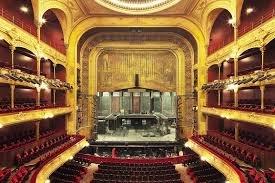
PARIS — The Théâtre de la Ville and the Théâtre du Châtelet, two of the most important theaters in Paris, will close for extensive renovations at the end of the 2016 season, darkening the houses for one and a half to two years.

The theaters, which face each other on the Place du Châtelet, next to the Seine in the heart of the city, were designed by Gabriel Davioud and constructed between 1860 and 1862. Both have been important to theater and dance history. Sarah Bernhardt directed the Théâtre de la Ville (at the time, named the Théâtre Sarah Bernhardt) and appeared there in her most important roles between 1899 and her death in 1923, and the Ballets Russes presented its first European seasons at the Théâtre du Châtelet.

Théâtre du Châtelet
Théâtre du Châtelet

The theaters have different artistic mandates. Châtelet, where “An American in Paris” is currently playing to sold-out houses, tends to program musicals and concerts; the Théâtre de la Ville is an important destination for international theater, contemporary dance and world music. Both receive large subsidies from the city of Paris: 17 million euros (about $20.5 million) a year at the Théâtre du Châtelet, which has an annual audience of around 320,000; and 10 million euros at the Théâtre de la Ville, which has about 260,000 spectators each year.

The announcement of the long closures, made this week by Bruno Julliard, the mayoral deputy responsible for culture, did not specify what arrangements would be made for the employees of both theaters (130 at the Châtelet, 110 at the Théâtre de la Ville, according to a report in Le Figaro). Although Mr. Julliard did not offer details, he said that the closures “did not mean that programming would come to a complete stop.”

He did not give figures for the renovations, which fall within a 100-million-euro budget for refurbishment allocated to the two theaters and a number of museums.

The Théâtre de la Ville, directed by Emmanuel Demarcy-Mota, has a second, much smaller house in the 18th Arrondissement, but its larger productions are unlikely to be shown there. The Théâtre du Châtelet, directed by Jean-Luc Choplin, is likely to have a harder time finding alternative venues, particularly as another Paris theater, the Opéra Comique, will also be closed for renovation for at least 18 months from mid-2015.

Patricia McBride-Still Living the Dancer’s Dream (Protege of George Balanchine)


Patricia McBride lived a dancer’s dream: Her mentor was George Balanchine

2   Patricia McBride and George Balanchine

Patricia McBride rehearsing with choreographer George Balanchine.

This was normal for McBride, then the New York City Ballet’s principal dancer (now the associate artistic director at the Charlotte Ballet), but working with Balanchine would have been a dream come true for aspiring ballerinas around the world.

He is known as an artistic genius in the ballet world. A gifted choreographer responsible for changing the face of dance and famous for the New York City Ballet’s ” Coppélia” and “The Nutcracker.” And this man personally invited McBride to join his company when she was just 16 years old.

Balanchine and McBride would work alone in a studio, not speaking much. Balanchine would cue the music and dance in front of McBride. A pianist himself, musicality was of the utmost importance to Balanchine. He wanted the dances to flow naturally, so he let the music do the speaking. McBride followed along behind him, learning the steps. Forty-five minutes later, McBride would have a new solo in her repertoire.

“He worked so quickly and he didn’t have to experiment with you. He knew exactly what you could do,” McBride said in a phone interview. “Once something was made to you, you had to remember it forever. You were the guardian of the choreography.”

Balanchine trained McBride for a 30-year career with the New York City Ballet. She danced over 100 ballets in that time, including 30 choreographed just for her. When she performed her final ballet in 1989, McBride was showered with 13,000 roses and a standing ovation.

But McBride did not leave dance behind. She went on to teach at Indiana University and then took over the Charlotte Ballet in North Carolina with her husband and dance partner, Jean-Pierre Bonnefoux in 1998. She’s now 72 and still teaches eight ballet classes at a time, on top of running rehearsals for performances like The Nutcracker.

This lifelong dedication to dance has been noticed by the outside world, too.

Earlier this month, McBride walked down a red carpet in Washington, D.C., to be honored for her commitment to the performing arts. She mingled with Tom Hanks and Sting, had dinner with John Kerry and met the Obamas. She was given a rainbow-colored Kennedy Center Honors ribbon and listened to actress Christine Baranski praise her accomplishments.

It was a celebratory weekend all about honoring the ballerina (among other honorees), but McBride was quick to thank others in our interview. Especially Balanchine, her mentor.

Theirs was an intimate setting to work in, but Balanchine was more than a teacher to McBride. She looked up to him as a role model and desperately wanted to please him. McBride‘s own father left her family when she was just 3 years old, so Balanchine stepped in to fill that role.

“I grew up without a father so he was everything to me — the man I most admired and just the most wonderful role model anyone could have,” McBride said.

And their relationship was not lost on the outside world.

“A true muse for George Balanchine, he created many ballets especially for her,” said Larry Attaway, executive director of ballet at Butler University. “She was one of the most remarkable ballerinas of the 20th century.”

McBride still remembers leaping for joy when Balanchine invited her to join the New York City Ballet Company all those years ago — and did not hesitate to give up a normal teenage life for one of endless rehearsals, travel and intense dedication.

Balanchine took McBride under his wing and trained her to dance his ballets, many of which are still performed around the world today. She traveled to Tokyo, Italy, Germany, London, Paris, South America and Russia to dance, including five performances for U.S. presidents. Leading roles in her repertoire include the Sugarplum Fairy in “The Nutcracker” and Colombine in ”Harlequinade.”

“I cherish the ballets made for myself by Mr. Balanchine,” McBride said in a phone interview. “He never lost his temper. He was quiet, humble, the genius of the 20th century. He changed the face of what dance is today.”

Balanchine was her teacher, her mentor and inspiration during her long-lived dancing career. He pushed her and drove her to perform at the highest possible level, but he was also kind and patient — a notable trait in the perfectionism-driven world of ballet.

“In the beginning, he taught you how to hold your fingers, use your head, hold your shoulders, how you glissade, bourre — the exact way he wanted you to do the steps,” McBride said. “It was relearning the whole Balanchine technique.”

He was not a man of many words, but when he did offer praise, it stayed with McBride for years to come.

“After performances he would say, ‘Good, good.’ He never really gave a harsh word. I don’t ever remember him saying, ‘That was awful,’ ever. He didn’t praise that much, but when he did, it was wonderful. He would say, ‘I loved how you used your eyes, you were mysterious.’ It would make you feel like a million dollars.”

Balanchine passed away in 1983, but McBride carries on his legacy by teaching her students his ballets with patience and kindness. She gives her students at the Charlotte Ballet Academy praise and talks highly of her “beautiful dancers.” She believes in nurturing her students and making them feel secure in themselves.

“Mr. Balanchine wanted me to be myself. He didn’t want me to look like anyone else,” McBride said. “I love teaching our company dancers the Balanchine ballets. I try to give them what was passed down to me and what I learned from him. They dance it so beautifully. It also keeps me close to Mr. Balanchine. He’s with me every single day.”

$9k xmas? How about….Margot Fonteyn’s ballet costumes taking a bow at auction


Margot Fonteyn’s ballet costumes taking a bow at auction – Bornrich.

​Misty Copeland: Still proving herself – CBS News


http://www.cbsnews.com/videos/misty-copeland-the-cover-girl-for-a-new-kind-of-ballet

​Misty Copeland: Still proving herself – CBS News.

▶ Anna Pavlova performs ballet solos, 1920’s


▶ Anna Pavlova performs ballet solos, 1920’s – Film 7224 – YouTube.

▶ Anna Pavlova – ‘Invitation to the Dance’ aka ‘Invitation to the Valse’ – YouTube


▶ Anna Pavlova – ‘Invitation to the Dance’ aka ‘Invitation to the Valse’ – YouTube.

Toledo Ballet – The Longest, Annual, Continually-running Nutcracker in the U.S.


WGTE Public Media: Toledo Ballet – Founding, History & the Nutcracker.

Alla Sizova, Star Kirov Ballerina, Dies at 75 – NYTimes Dance


Photo

The ballerina Alla Sizova in costume for “The Sleeping Beauty” with the Kirov Ballet Credit The Leningrad Kirov Ballet


Alla Sizova, one of the leading ballerinas of the Kirov Ballet during the 1960s and ’70s and an early partner of Rudolf Nureyev, died on Nov. 23 in St. Petersburg. She was 75.

A friend, Marina Gendel, said the cause was cancer.

Ms. Sizova’s outsize talent was apparent even before she joined the Kirov (now the Maryinsky) in 1958. When she was still a student at the Vaganova Ballet Academy in Leningrad (as St. Petersburg was then known), her extraordinarily high jump and astounding technical prowess as the Queen of the Dryads in a school performance of “Don Quixote” won raves from the Leningrad critics and a nickname, Flying Sizova.

Her graduation performance was the pas de deux from “Le Corsaire,” in which she was partnered by the young Nureyev. He challenged her to substitute the more difficult Dryads variation for the usual one, and to further increase its difficulty by adding double pirouettes to a series of virtuosic steps known as Italian fouett?s. Few ballerinas, if any, have since repeated that feat.

Ms. Sizova was part of an exceptional generation of Kirov stars that, besides Nureyev, included Irina Kolpakova, Alla Osipenko, Yuri Soloviev and Natalia Makarova. Ms. Sizova was paired regularly with Nureyev in their first years with the Kirov, and the Soviet authorities gave them an apartment to share.

(In her 2007 biography of Nureyev, Julie Kavanagh quotes the ballerina Ninel Kurgapina recalling Nureyev’s reaction: “They’re giving me a flat! With Sizova! They think by doing so I’ll eventually marry her! Never!!”)

This group of dancers caused a sensation when they were seen on tour in the West in the early 1960s, Ms. Sizova not least among them. Reviewing a Kirov performance of “The Sleeping Beauty” at the Metropolitan Opera House in September 1961 for The New York Times, an enthralled John Martin began by writing, “If Alla Sizova of the Leningrad Kirov Ballet would like to have the City of New York, all she has to do this morning is ask for it.”

Alla Ivanova Sizova was born on Sept. 23, 1939, in Moscow, only weeks after Germany invaded Poland and started World War II. Her family moved to Leningrad soon after, but in 1941, Alla and her only sibling, a sister, were evacuated with their mother to the Ural region in the east. Her father remained in Leningrad, which by then was under siege by German forces, to work as a driver delivering bread.

The family was reunited in Leningrad toward the end of war, and Ms. Sizova began to attend an after-school dance program. Her talent was noticed. She was accepted at the prestigious Leningrad Choreographic School (later to be named after Agrippina Vaganova), where she was taught by Natalia Kamkova.

Unusually, she was taken into the Kirov Ballet with the rank of soloist, and promoted to principal soon after. During her first three years with the company, she performed at least 14 principal roles, including Masha in “The Nutcracker,” Princess Florine and Aurora in “The Sleeping Beauty,” Myrtha in “Giselle” and Katerina in “The Stone Flower.”


A back injury kept Ms. Sizova offstage for two years in the mid-1960s, but her career continued to flourish well into the ’70s, with particular acclaim for her performances in “Giselle” and “Cinderella” and her spirited Kitri in “Don Quixote.”

Ms. Sizova also created roles in a number of ballets, including Igor Belsky‘s “Leningrad Symphony,” Konstantin Sergeyev’s “Hamlet,” and Oleg Vinogradov’s “The Enchanted Prince” and “The Fairy of the Round Mountains.”

After Nureyev defected to the West in 1961, Soloviev, another brilliant young dancer, became her regular partner; in later years she also danced with the young Mikhail Baryshnikov.

Ms. Sizova married Mikhail Serebrennikov, a television producer and director, in the early ’70s. They had a son, Ilya, who was 6 when Mr. Serebrennikov died of an aneurysm in 1980. Ms. Sizova retired from the Kirov in 1988 and accepted a teaching position at the Vaganova Academy.

By 1991 Mr. Vinogradov was running the Kirov-affiliated Universal Ballet Academy in Washington and invited Ms. Sizova to join the faculty. The Soviet Union was dissolving, and Ms. Sizova was able to move with her son to Washington.

There she became a much-loved teacher, noted for her emphasis on musicality above technical proficiency and for her kindness to her pupils.

Her son had meanwhile returned to live in St. Petersburg, and when he died in a drowning accident in 2004, Ms. Sizova, too, went back to Russia. Mr. Vinogradov tried to persuade her to come back to the United States, or to rejoin the Vaganova Academy, but she refused and became a recluse, rarely seeing former colleagues or pupils while living with her sister, Nina Ivanova, who survives her, along with a niece.

Ms. Sizova developed Alzheimer’s disease in the late 2000s and received a diagnosis of cancer four months before her death.


Sophia Kishkovsky contributed reporting from Moscow.

Alla Sizova, Star Kirov Ballerina, Dies at 75 – NYTimes.com.

▶ how….it should be done….Sizova Kunakova Efremova Evteyeva Komleva Paquita Variaciones – YouTube


▶ Sizova Kunakova Efremova Evteyeva Komleva Paquita Variaciones – YouTube.

▶ La Vivandière (Kirov) – Alla Sizova – Boris Blankev (1982)


▶ La Vivandière (Kirov) – Alla Sizova – Boris Blankev (1982).avi – YouTube.