Tag Archives: Performing Arts

Turn-out, Injuries, Hips, Knees and Feet: The importance of not overtraining, crosstraining, and specifically strengthening the opposing sides….


Margaret Barr's "Strange Children" [...
Margaret Barr’s “Strange Children” [ballet], 1955 / photographer unknown (Photo credit: State Library of New South Wales collection)

Dancers are strange children. For what other persons would set out to achieve the impossible, inch by inch, seeking a kind of perfection and freedom which allows them to communicate to others more artfully, those existing ballets created for bodies conditioned for performing these unbelievable and frequently imperceptibly impossibly difficult steps and combinations of steps? To the untrained eye, this intentionally looks easier than it is. But as they attempt to achieve more and more of the masterpiece that remains in the dancer‘s brain, only the very successful are considered to be so, and no one but a consummate artist can detect many of the imperfections and flaws contained therein. Certainly, no one but ballet dancers understand this, or stand united on the subject. Modern dancers detest it. The public doesn’t get it. And the trick is after all of that, dancers are forbidden to let you see their hard work. It is truly an art only really appreciated, deeply, by the best. And only they can criticize it, develop it, or lay at our feet the secrets of it. For most dancers themselves, you will find, find it difficult, if not impossible to explain, not all of it, anyway. They try. Misogynists or mystics?

jose limon

That photo is of Jose Limon. Sometimes, my thinking (and writing) delves into deeper, or more technical, areas where I am not an expert, but have concerns on the subject. Problems and experiences we have had may help to serve other people similarly facing such issues. That is by no means stating that I am, or have become, and expert on the subjects noted. It is very possible that I am wrong in stating some things, but I am thinking it out as I go-is there any other way? It is merely a line of thinking that I have found, or measures, which may prove to be, helpful to others. So I think, in this instance, I will share this. My daughter, has for some time been dancing and she is a hard worker. Because she started later, and had to learn so much to be caught up and prepared for her age level of dancing, she has traversed, in instances, very quickly, the long-practiced maneuvers, steps and poses of other ballet students, who frequently do not understand WHY they do things, or WHAT they are doing, but they do it everyday. So this is good for them, too. In addition to speeding up her practicum to achieve her dancer-sylph, she had had to work on her various short-comings.

All dancers have them. Each one, each area of the body needs to be fit, balanced and prepared for the hard work to come. getting to that point is obviously frustrating for even the best dancers (and the keeping it of it is also a repeated task). All dancers find they have some shortcomings. As the years, or levels, pile up, the dancing becomes more difficult, requiring the basic ability to execute various steps, and combinations correctly, and then more ability, and ultimately-perfection. But even at the preliminary stages when working, quickly, or more rapidly than they are accustomed to, and throughout your dancing career-however long that may be-foundation is forgotten in the moment of dancing, and you just dance as fast or as well as you can. It would admittedly be, a very tedious process,  if one had to stop every minute or so, and correct oneself, be corrected, or think about it, but that is what needs to be done, and what should be done, but it is NOT what is done beyond the basic level for many dancers. This is how most injuries occur.

Over-training is another common way to injure oneself. In order to become better, faster, it is very easy to get hurt and when you add on to that any other frailties, anatomical differences, technical abilities or shortcomings, it is a recipe for injury of some kind, all kinds, and we are finding-most kinds. One injury, when working at so high a level of training, can spiral outward, on the mend, with less than active (not as active) muscles, and result in consequential injuries, either to the first, or new. You almost can’t stop, but then you HAVE to. Most injuries will get worse if you continue to dance on them making the recovery time inevitably  longer and the possible injury itself-worse. My daughter’s injuries nearly all fall into this category, for nothing is essentially wrong with her-thank God. She is not deformed, has straight legs and only some hyperextension issues, which believe it or not is becoming more noticable with stretching and straining to become a ballerina. When anything is overstretched, it is a problem. Always.

She will have to watch out for these and many other injuries in the future, but for starters, these have been enough. In a nutshell, too soft pointe shoes (little support) resulted in an achilles injury (and a failure to really work her feet to make them stronger). While taking it easy on that (for months) and stretching to become able to do higher poses, achieve more turn-out and better grand jetes, she torqued her knee (and after 21 performances of Nutcracker, or something very close to that). Mind said, “turn-out” in plie, and knee refused. Overtraining and fatigue, I thought immediately. Then, while recuperating from that (80%) is about all I could rein her in-she experienced a deep groin pain preventing her from turning out at all, for no apparent reason. Many days had I suspiciously eyed her laying on the floor in the butterfly position, and thought,”too passive”, but….I was right, and wrong.

The hip injury is getting better, but for many weeks she has not been able to do much (involving turn-out) that does not cause pain. Oddly developpes do not hurt, while a simple ronde a terre-does, and a tendu! Movement of the whole leg in the hip joint. The hip. I came up with this after much research and found that most hip injuries in other dancers are down to five and we did want to rule-out the femoral fracture (Harkness/NYU). Whew! But all of them which did mention a pain, were on the outside or front of the hip and not deep inside it. The bad ones were deep, but, we knew it was

HTC modded keyboard running on my Samsung
HTC modded keyboard running on my Samsung (Photo credit: DanieVDM)

getting better and was not related to hip popping, so that ruled out all the rest except the femoral fracture-common to dancers, and she did not feel it was broken (she would deny it if it was!). They are very easy to break actually and require surgery…. Movements to the side hurt more and above the hip line in front???  Only certain positions means certain ligaments or muscles. Sometimes you can feel warmth (none), notice swelling (Ibuprofen), but she didn’t and neither ice nor heat were particularly effective. A warm bath might help, but it did not.

All of these things should be noted, and a journal should be kept following injuries so you can remember the activity associated with it that causes (caused) pain. My dancer cannot always recall what she was doing when it happened, especially if it becomes worse after class-could have been anything! A doctor will ask. The more you know, the better diagnosis they can give. Dancers do not like to think about their injuries, let alone, keep a journal of them. Morbid, but effective. Tell them to try recording it on their phones. Most Android phones have this capability and the recordings will show up in S Memo (or in Apps) and Media-they can find that; it is very handy for the lazy speakers. I did not say “lazy dancers.” These notes record by voice, too. Tell them to tell their phone to “record a memo.”

Her second injury, to the knee, I felt sure was related to her turn-out issues. I did not expect it was a turn-in issue. But is is. She has a great turn-out, but a poor turn-in. The doctor confirmed this, and we also ruled out hip or foot problems-basically they are perfect for life. We are still learning about dancing. Too much turn-out (stretching) has resulted in two injuries from weak turn-in-specifically the adductors and the hip muscles. If one is over turned out, and the body has to suddenly transition to a turn-in, and does not react quickly and forcefully enough-the counter-muscle strains-the one that helps you control turn-in and turn-out. Over turned-out-funny. In stretching, most dancers fail to realize strengthening has to be done in equal amounts as stretching, of the same muscles, for support and control. Teachers do not explain this. At all. And apparently, not effectively, especially for young students who have short attention spans.

For anyone involved in the serious study of dance, no doubt, the discussion of turn-out has arisen in class. You probably know by now if you have good or perfect turn-out because you will have heard it from teachers. It’s the next thing down from “feet.” Remarkably, many successful dancers have notably deficient turn-out. It is the actual foundation of all classical ballet. It is stated by doctors that the ease at which it is obtained (sometimes) appears to be correlated with the age at which dancing is begun. In short, turn-out is relative to ballet, therefore, it will be stated by some that it should be learned early. It is and it is not. Let me re-state that many professional dancers turn in all the time-they fail to remember to turn-out. It is perhaps the conditioning of it, not physiologically, but mentally, that makes it more well-remembered by the earlier you start, but in fact, that has to do with memory and not actual ability to turn-out. There is also functional turn-out and structural turn-out. Even those very rare students with “perfect (structural) turn-out,” turn-in (do not have good functional turn-out). It is not only one part of the hip that is actually responsible for how much turn-out one has, and actual deformity-again, popular in ballet (only), does occur, and is therefore deemed “perfect.” FURTHERMORE, it is just as important for dancers with this turn-out to remember, all the time, to turnout at the correct times-and they don’t! Children who do not want to work on turn-out are quick to notice this in professional dancers as “okay,” but it is not, necessarily. Everyone is different!

Perhaps they can exhibit better turn-out, which is nagged about in the studio, but face it, when they get on stage-they forget. Any dancer is only trying to remember 6,000 things on stage, and as you watch most of them, particularly soloists, you will notice they turn in, frequently, or you will notice that they do not exhibit their perfect turn-out, except when at the barre in first position or in plies, in second. Ligaments change, and dancers have to not only stretch to initially achieve turn-out, and exercises to strengthen it-do not stop at the barre (I’ll tell you why), but most dancers have to maintain their own degree of turn-out by stretching daily and remembering to reinforce turn-out in the studio and while dancing, all the time, for the rest of their lives.

As people get older, much older, all of their ligaments and muscles begin to deteriorate, so not exhibit the same elasticity as when they were younger, but dancers continue to dance, turned-out, or turned-in, and they continue to get nagged about it, until it is second nature, for the most part, for them to remember to turn-out or they get beyond the point professionally when any teachers complain about it anymore. That is one indication of a professional-not having to be taught anymore. It is up to the dancer to work on it, keep it and nurture it. Holding turn-out is how you refer to it in class and that is exactly what it means. Therefore, it is not the degree of turn-out which is extremely important in all dancers, but their ability to control it; that requires strength! And the lack of control causes injuries. Wait and see or get on it now, to prevent  injuries.

Dancers with perfect turn-out also turn-in, because of strength issues-not just memory loss or forgetfulness. It is the body’s natural inclination to do so, and the mind of a dancer must think about so many other things, occasionally (LOL), that sometimes it can just go-that is why you train to control it, so it goes where you want it to, and how far you want it to.

There are many exercises in ballet, poses in variations, and most importantly, but never mentioned,transitions in classical ballet, which cannot be accomplished without injury to a dancer who does not possess adequate turn-out to do them. Perhaps more importantly, not turning-out first and then failing to hold the required degree of turn-out can be dangerous if not life threatening, then dance threatening (and this is the worse of the two-for dancers!). This is anatomy and physiology, and fact. It is fairly safe to say, then, and I do, that all dancers turn-out excessively, whether good schools tell them to or not, they learn to, it is conditioned in other ways, even if teachers tell you they do not force turn-out. They teach turn out, refer to turn-out and yell, “TURN OUT,” and they have to if they teach Ballet.

English: First Position of the feet in Ballet
English: First Position of the feet in Ballet (Photo credit: Wikipedia)

Notice the “over turn-out” in first position? Slightly? What is too much for many persons is simply put, too much without control. I always releve (turned-out) in every position, just to check that my alignment is correct and that the right muscles are engaged, and that I can releve from that position. It is evident when doing this, if you feel awkward, or forced, that you are! Fix it-turn a little tiny bit in and gain control from that position before you open further. Practice making transitions and moving from these positions, think of variables, so that when the time comes, it is no sweat-you have done that before, and the body remembers it. Sometimes, I also attempt a plie from whatever position this happens to be, all of them, to make sure there is nothing wrong, to see what I can do, and to strengthen infrequently used muscles that may contribute to a better position in the end, by cautious means. What a lot of teachers mean by teaching turn-out young is that they can put dancers in over turned-out position and due to the laxity of the muscles at that age they do not readily see injury-that does not mean that it is not occurring, only that you can’t see it. Ask Mikhail Baryshnikov about his knees and forced turn-out and I am sure you will get an earful. I have found, over the years, that my habit, hard to instill or demand in others, fixes almost any turn-out problem, assures that I can execute the position(s) correctly (with the correct amount of turn-out), in transitions, or quickly, without hurting myself, and that after years of doing it, I have no issues or injuries! It’s like falling, with practice, you can learn to fall without injury, or with substantial reduction of injury. Falls happen-practice. After years of doing this, and I am much, much older than any of you reading this, it helps strengthen those muscles directly associated with each position, the best. How do you learn to surf? You surf. Is there exercise for learning to surf or be a better surfer? Yeah, surfing. How do you build up the muscles used in surfing? Surfing. Practice, practice, practice-not repeat, repeat, repeat! Also, holding these positions is easier after many repetitions, and many years. I have good balance from it in most ballet positions, and I haven’t really danced as hard as you are for 30 years! But I still do the exercises….

If, as a dancer, you attend a new class, and the teacher has you do something for which you are not physically prepared to do, you will fall out of it. That is the best sign, this muscle is not trained. Train it by doing the exercise over and over. Do not think to use the fail-safe quadriceps for anything except stability and pumping-force. The Amish say, there is always another way, and there is almost always another muscle that needs work when your quadriceps engage to protect you-they do not jump into action unless it is to protect you from a major tumble-from everything. The finer muscles responsible for controller finer movements-are ignoring you, not engaging, not working, because you haven’t trained them to listen. Most dancers think they have no faults, are not lazy, but mentally, there are things we just do not bother to do. We ALL do this. We also rely on routines and it is virtually impossible to do all of the exercises you need to do in one routine, so make list and rotate them-less chance for injury! It is hard, harder than 64 small jumps in center, all of them a foot or more off the ground, and then again, because it seems so easy we just take it for granted, but I bet you can do those jumps. Working and strengthening the finer muscles is hard, because these muscles are hard to find, hard to visualize, and they all work together at times, making the isolation of them very difficult to sort out, or the use of them fathomable. They are truly not as complicated as they seem, but you have to take the time and think about them, research them, practice using and finding them-or try to-and prevent injury.

Adequate turn-out for dancers is that degree of turn-out required for that dancer, based on his/her body structure, bone shape (especially the femur, acetabulum and pubis) which determine the range of movement of the hip, and also the ilio-femoral ligament, obturator externus (front-see picture below), and piriformus, gemellus inferior, obturator internus and externus (front), which in addition are responsible for the strength of the hip movements. Overstretching in the butterfly, for example, which virtually no teacher will tell you is harmful (“do it 3x a day!”), but it is. It is when you do not strengthen the hip, or stretch the hip sufficiently in the opposite direction. But enough is said about this to beginning or ambitious dancers who
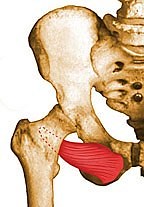
OBTURATOR EXTERNUS MUSCLE

must stretch to attain a better degree of turn-out and they need to be particularly watchful, especially if they are teenagers. No exercises are specifically given for it in ballet class. Repeated 2x per day, these stretching exercises can overstretch the adductors, resulting in serious groin pain in the student, usually deep in the tissue, where ice and heat may have little impact. Ibuprofen can help, but must not be relied upon for daily use. The pain can be so severe the dancer cannot turn-out-that is actually the key to the cause of this pain, for most other injuries to the hip result in different kinds of pain inside or outside the hip, but not affecting the turn-out per se.

Piriformis - Muscles of the Lower Extremity An...
Piriformis – Muscles of the Lower Extremity Anatomy Visual Atlas, page 8 (Photo credit: Rob Swatski)

From all of the material I have read about possible hip injuries, it is my own conclusion, and that of a venerable dance doctor, that without sufficient strength in the adductors, and overstretching present, a sudden twisting or turning can result in a straining of the muscles of the groin and on the inside of the upper thigh if they lack the tone to prevent overstretching. The pain in the upper thigh is frequently called “rider’s strain,” and is caused by too much stretch of the adductors when doing movement a la seconde (Dancer’s Book of Health, L. M. Vincent). It is said that some dancers, with ligament laxity, may even feel the thighbone “go out of joint.” This continual dislocating may lead to joint degeneration, so the importance of good muscle conditioning and avoidance of over stretching cannot be ignored! He says to “always seek control more than height”, and when warming up, do not risk strain by caving in to the temptation of placing the leg on the barre for the first stretch. Check with your dance teacher/physical therapist before performing these exercises to make sure they do not interfere with your goals.

Interestingly, students who feel that they do not possess enough turn-out can fall prey to this type of injury if their leg is inclined to drop “backward,” so they will often find that their turn-out is not lacking, but rather their ability to control it is. These types of exercises will help, but for specific muscle attention (there are six sets- count them- of muscles and ligaments responsible for turn-out, and a few other muscles besides) it would do to look up and verify which muscles to strengthen, what each set does, and the individual ones, and to go over where they are, when they are used and what to do to strengthen each one and each group, just to prevent injury and to be aware of this rather complicated area of the body, prone to injury in female dancers with a high level of ballet classes, training or just plain dancing. There are classes, sometimes, led by physical therapists (and dancers) to integrate whole body strengthening and conditioning to prevent injury in the different parts of the body that ballet dancers are susceptible to. These injuries are particularly a problem for adolescent students for growth and hormone reasons. Look no further than the Nureyev Foundation in Switzerland, to locate a dance doctor (a real one-not a quack) in your area, or a dance-trained physical therapist, who can help you discover more about your dancing body and its limits, as well as its possibilities!

http://www.noureev-medical.org/content/contact-information

Deep muscles of the medial femoral region.
Deep muscles of the medial femoral region. (Photo credit: Wikipedia)
Your hip adductors (left) are all responsible for moving your leg in toward the midline of your body–a movement called adduction. Located on the inside of your thigh, your adductors stretch from the inside of your knee to the bottom of your pelvis. Strong adductors are important in knee and hip stability, and if they become weakened, you may find your knees are prone to dropping outward. Additionally, performing exercises for your adductors will tone the area of your inner thigh. There are a variety of exercises you can perform for this important muscle group.
Medicine Ball Squats

Stand with your feet hip-width apart. Place a light medicine ball or soccer ball between your knees. Keeping the ball in place by squeezing your knees together, squat until your knees are bent to 90 degrees and your thighs are parallel to the floor. Push your hips forward and straighten your knees to stand up. Make sure that you concentrate on pushing your knees in against the ball throughout this exercise.

Lying Side Inner Thigh Lift
Lie on the floor on your left side with your body straight and your head resting on your outstretched left arm. Cross your right leg over your left and place your right foot on the floor, creating a figure-4 shape and allowing space to lift your lower leg. Raise your left leg inward by using your adductor muscles. Lift your foot 8 to 12 inches off the ground. Slowly lower your foot back to the floor and repeat before rolling over and changing sides. Make this exercise harder by wearing ankle weights-no more than 1 lb, and work up to that!

Hip Adductor Machine

Sit on the machine with the leg pads against your knees and your legs as far apart as comfortable. Press against the pads and push your legs together until the machine arms touch. Pause for one to two seconds before slowly returning to the starting position and repeating. This machine can strain your muscles if you are weak here, as most dancers are, it is advised to put it on its lowest setting and do no more than 12 reps the first several times, working up to three sets of 10 or twelve. Dancers also have to be careful not to bulk up-so many of these exercises have to be done in moderation, compared to general athletes, or those trying to get into shape. Dancers have a preferred shape, and need to remember to work the opposing side EQUALLY. In this case, that means, to put the pads on the outside of the leg and reverse the exercise. Most dancers will find it is easier to press the pads out (a no-brainer), than in. That is where you need work!

Lying Pillow Squeeze

This one is easy, so you will really feel “the pee” muscles working. My daughter hates it when I say this. Lie on your back with your legs bent and your feet flat on the floor (also on the bed or while you are waiting for lights to change to green in the car-anywhere and from any position). Place a large pillow between your knees. Keeping your head on the floor and your arms by your side, press your knees together and squeeze the cushion as hard as you can for five seconds. Relax slightly, but keep the cushion in place. Push your knees together again and continue repeating for the desired number of repetitions. Only a few will be possible at first, so do not overdo it. It is more important to hold it for 5-10 seconds than to repeat it often. It is also more challenging. Work up!

Many dancers experience imbalance between the hip adductors or inner thighs and abductors, the hip and gluteus muscles. To counter this muscular imbalance, here is a stretch which needs to be held at least 30 seconds. Personally, I do not recommend “adjustments” like pulling the leg (performed by some over-zealous chiropractic offices, and  frequently, without any warning!).

Preparation:

1) On floor or mat, lie face up with arms extended at sides

2) Lift one leg straight up then bend knee and hip to 90 degrees flexion

Execution:

1) Lower bent knee leg to opposite side toward hand.

2) Hold stretch for 30 seconds, maintaining 90° flexion in hip with both shoulders flat on the floor.

3) Repeat with opposite side.

For definition and reaffirmation:
Think that some dancers use the outer thigh more than they ought to, when it is the inner thigh which is typically responsible for turn-out.  Working the turn-out muscles require isolating them and using them-nothing else will work. The adductors are the frequently forgotten five muscles of the inner thigh that connect to the pelvis—the Pectineus, the Adductor Magnus, the Gracilis, the Adductor Brevis, and the Adductor Longus. Look those up and write down their meanings, then locate them in yourself and work on them. When a dancer has had an injury to the knee, for example, these muscles will have atrophied while the dancer was resting from the knee injury. The tendency for the dancer to resume the level of previous training that his/her body was accustomed to is presumed, since most dancers who have not had a previous injury will not be aware of or expect these initial limitations so they just jump right back into class “to get back to where I was”! Right? NO.WRONG!!!!!!!!!!!!
Even a few days off, literally, can lead to some scary loss of muscle tone and requires s-l-o-w and steady passive and active stretching to get back to ground zero. I also recommend the warm-up exercises of Ballet for Dummies (Evelyn Cisneros is one of the authors-and certainly NO Dummie!) In it, they well discuss passive and active stretching and the importance of EACH for dancers. Too much passive stretching before dance class can also lead to injury in dance class. Best to do moderate exercises (warm up) before class, and stretching OUT after class, for up to 45 minutes.
Yoga and Pilates demand strong inner thigh muscles — fortunately, routine practice of both strengthens the inner thighs.The Pilates Reformer is also said to produce amazing results, but work with a trained professional. Don’t do any stretch to the point of discomfort and don’t force any stretch. Work up!
A good stretching program is key to maintaining muscular balance. Hip and adductor muscles are focused on in CORE workouts, but prior to this, which can result in overworking some muscles and under working others that dancers use, dancers had to rely on themselves to diagnose and usually fix what was wrong, and in good ballet classes, teachers address this, usually through modern dance techniques and other exercises. There are many modern dance exercises which I believe prevent any issues in these areas through dancing. On The Count of One and The Dancer Prepares give some really good advice, and there is no end of information available on the subject. You will not hear this through an orthopedic doctor, who relies on personal links with general physical therapists to practice exercises, get patients “back”, which might be good for octogenarians or football players, but are not fulfilling for a dancer beyond an early stage of injury recovery. Dancers demand more-faster.

Although some of the same muscles come into play with athletes and the general population, dancers refine their use, and rely on a good deal many more muscles than does a football player, and also work at a higher level of training each one for specific uses not understandable to most orthopedic doctors unless they are also dance professionals. A dancer also uses them a lot more and a lot more turn-out stretches, means a lot more and tougher turning-in exercises. My argument here is that most of these types of injuries are turn-in injuries, rather than turn-out injuries, actually. A good modern (basic, then intermediate) technique class-Graham or Horton is best and can also work absolute wonders to this balancing act; it can act as the antithesis to ballet, thus working all of the needed muscles in a dancer’s range, while being easy on the body, when exactly properly performed, and done at least four days per week for any significant results. Since this is not available or possible for all professional dancers (who do not have the time to become modern dancers), many of them rely on yoga. Yoga is everywhere and gets you in places nothing else does, but is not as active as modern, and not dancing.

The important points here are to listen to your own body, and do not readily accept the physical therapy or medical advice of a medical professional untrained in the dance profession. Dancers are different and require the patience themselves to identify areas of concern, underwork, overwork and injury. All bound together, usually. Any pain in executing any position might indicate the dancer is doing something wrong, and the sooner this is diagnosed and corrected, usually through re-teaching and strengthening the affected part, ASAP, the better. You might say that dancers are continually pushing the limits and need to train smartly. They hold their fate in their own hands and how they approach such injuries can be the end of one or most connected injuries as well, or the beginning of several more related ones. Therefore, it is important to sort it out, when you can’t dance it out.
Keep on Dancing!

What Was That Combination?


May is underway already and my daughter has been attending ________Ballet School for over one year now. She has had many ups and downs, working very hard, but she has definitely improved. I see a fine dancer emerging from her. She has grown in confidence and strength, although she needs more strength, I hope it will come. Strength is apparent in many things, not just ballet. I learned when growing up, and finding dance, that dancing is not only good for the soul, it is good for discipline, is character building and improves your ability to perform just about any other lesser sport, such as volley ball, etc. I found that after a few years of dance I was able to play sports with above average ability, that previously I just wasn’t into at all. Every year my grandfather used to buy me sporting equipment, baseball, bat and glove, badminton equipment and a net, ice skates, roller skates, and one year we even bought a tennis racket from someone in The Trading Post (where he spat in a dog’s eye), and all of these things I tried to eschew for him, and more, but to no avail-they just did not enthuse me. I swam every day in the summer, sometimes staying at the pool until after dark, but other sports I just didn’t excel at. I remember the other girls driving home other players in softball, and standing in the field letting the ball go by me-irritated, that is what I was. In volley ball I could not serve a ball over the net with any force or impetus. I could run. I climbed trees. I did roller skate, but not with any stability or verve, and not as well as my friends. I could ice skate pretty well but they closed the rink. No one I knew really played any of these different sports and surprisingly it was not kids from my local school that would go to the pool. But I did make friends. I walked and we danced to popular music a lot. We wanted to have a girl singing group, or my friends did, mostly I just liked the music and to dance. I was creative in many other ways though, drawing, I could build things, and I did go through long periods where I would just sit by a window and read books, until my mom had enough and kicked me out to go do something else, and “not be a house plant.” Maybe that is why I put my daughter in ballet. Because after ballet, I could do anything better than anyone else, practically. It just made me an athlete-confident, strong and focused. It is what I needed. When I had a teacher that said to go back and do something over, I didn’t complain, but just went and did it. We didn’t have much money, and I paid for classes myself.

The world today is different, but what ballet can do for you is not. I know I didn’t put my daughter into ballet thinking,”she is going to be a ballerina.” I put her into ballet so she could see what she could do with herself, to grow in confidence, to use all the muscles she wasn’t and to gain some discipline. Each day, she grows a little (almost two inches since August 2012) in stature, and is beginning to “know what she knows.” She is beautiful to me of course, but I can begin to see the woman she might become, all the more confident and lovely each day, and ballet helps-it works wonders! She knows that ballet makes her special, and that we cannot avoid in our children-why should we? But, todayI asked her why she did not ask her friend to join her in a modern class one day next month, and she said “no way.” I thought,”Well!” I said, to take _____wouldn’t be so bad for her, she might like dance, thinking, certainly she is not competition yet, and why would she say “no?” Well, I can remember wishing my friends wouldn’t take ballet, because I felt it was mine. I didn’t want to be competitive with them, I just wanted them as friends. As soon as one of them did take a contemporary class, by my example, I immediately left off that friendship, and now I feel remorse over it. Well, not exactly remorse, but rather I see now that it really doesn’t make a difference who takes ballet, and to have a friend in ballet does seem like an impossible thing sometimes, but it happens, when both parties are mature enough to realize everyone is different. I think that girls in ballet ought to have the same kind of trust exercises required of boys and girls in ballet in pas de deux classes. Girls should stick together-boys do! But do boys in ballet? But this has never been done, addressing these issues of petty competitiveness which actually serve to make us better dancers, strive harder, follow other examples, laugh and have fun, support each other when we fail, or fall, instead of smugly thinking, “it serves her right-good-she fell!” Wishing other dancers to fail is actually bad-not good, and we always think of other dancers as merely competitors, but we need to put this in the right perspective, for without other dancers, who would we have to be better than? Or better put, possibly, we are only as good as the best person in the class, and seek to be better than that person, whoever it is, and without them, our bar just went down to the next best person. How does that prepare us as dancers for the rest of the world?

One thing I noticed about my daughter when she was just starting ballet in I think, her second year (she was eleven or twelve), and that was that the teacher created a lot of competition between the girls by praising one or two, and my daughter was from that moment on, determined to be better than that one, or every one, at every thing, and I found myself using them to explain that while she was good at these things, this other dancer was good at these other things, but I did not have to-she knew. And she likewise talked about this, but mostly it served to try and make herself better. There were some things she knew this other dancer had, such as ridiculous feet, but she spoke with sympathy about the other faults the girl had, and it did not take me long to realize that my daughter did not really feel sorry for her faults, she was happy that she did not have those faults (at least). Subsequently, I have not tolerated (often) the talking down of other, better in some ways, dancers, who have been selected for summer programs, year-round programs, scholarships, etc., that my daughter coveted. In fact, when the teacher gets after these other dancers after competitions, too much, to try to instill some humility into that dancer, I pointed out to my daughter that the teacher was possibly only doing this to make the other dancers feel better about themselves and to spark competition between the dancers and this child, who is a good dancer. Who is? She has most of the physical qualities companies look for in their dancers, and she dances pretty well, I think. I said my daughter ought to substitute, in the phrase,” you only have good ________, something that she felt confident about in herself, her vanity-and apply the entire criticism, personally, for if she did not, she too would run the risk of thinking she was too good, better than everyone else, would not strive to become better in that area, other areas, or feel she was good enough, or better than everyone in her class/school.

I suppose I am too jealous of the corrections. I wanted them ALL as a dancer, and every dancer is aware of whom the teacher is giving corrections (mostly) to, and envies or pities that person, but any correction can and must be applied to oneself if there is to be improvement of a substantial nature and understanding of ballet. Yet, professional dancers can almost never broach criticism, particularly when they turn to teaching or the direction of a school. They automatically think they know everything and must be respected above all other parties for their expertise, by their students and parents. When opening up communication between parents and teachers might result in improvement in not only the dancers, teaching but teach these children that as a group they are strong. If students witness their own teachers vanity and those at other schools, are we not grooming htem to be vain peacocks, like their teachers, instead of artists and dancers? It is an art. It is not simply put, being someone people want to watch dance because you are pretty, otherwise why would we say of Plisetskaya that she was “beautiful when she danced?” It is not just gymnastics, otherwise why would Pavlova’s teacher said, “cease these gymnastic routines! They are not for your delicate frame! I shudder when I see you try to compete with the gymnastic didoes of other dancers, for delicacy shall be your mien, your strength.” It is not the early starter who can burn out or be injured, for otherwise we would not have had Rudolf Nureyev, Margot Fonteyn, Gene Kelly, Suzanne Farrell, Misty Copeland and many others in many countries at many times (I am so tired of reading you can’t when you can-if only you will!). It is not merely technique, or Vaganova would not have been compelled to  create a science of movement and training, and there would be no great Russian dancers. Without Isadora Duncan there would be no history of contemporary dance, exercises by her, or any dances, ballet or otherwise in a tunic, and all dancers would probably wear scarves! There would be no modern dance. It is not likely that there would be just one ballet, one choreographer, and no variety of music to choose from, but there is, and there are many varieties of dancers, including many types of ballet dancers. Students of dance need to realize they are not the only ones, and they should be taught to accept challenges, open invitations to other people to dance, prepare to perform, dance, and that this does not change their ability at all. In fact, it makes them grow. It is hypocritical to say, ” I love dance, and I want to see dance continue and ballet, in particular, to be popular”, if you shut out competition, other dancers, others schools, choreographers-you do nothing for the art. Watch “Chocolat.” If no one tries it, they may not ever be advocates of it, may not seek to see it performed, understand it, and may only enter their children in it as competitors, to be better than everyone else at gymnastics, or prettier, or at technique, or performing-it is all inclusive. Ballet needs to open its doors to adults, all children (rich and poor), all kinds, in order to survive.

I told my daughter that if her friend attended a dance class, perhaps she would invest in my daughter’s dance company one day, her grandmother is very wealthy. Perhaps they would have more to share-not less. The focus should not be on the end result, but the process. The process should be an enjoyable one, and the experiences at our dance studio suffer because of the competitions, the parts which everyone fights over, the parents sitting in their cars because of the perceptions that 1) Their children are not that good, 2) Are overlooked, and 3) The competitiveness between the parents-which is passed on to the children in most cases-not all-to the point that these dancers are not NICE. My daughter, is always nice, congratulates everyone, and genuinely cares for them and they do not like her one bit. Funny. Jealous and her teacher just quit giving her privates because we had a fight and he said she would never get into a really good ballet company. This is just ridiculous-who cares? She does, but it is ME he got into the fight with. He likes her, and even though it was awkward, she says, at first, now he looks at her when she isn’t looking, comes over to correct her (like he used to), and she is recovering from her latest injury (in the hip) so is able to do more each day. For us, everything is looking UP. She decided not to go to ABT (more about that later), not to go to The Rock, not to go to Dance Master Class (Italy, this year-see my Pinterest), and not to go to English National Ballet in Ohio. Instead, she is taking the summer session with her favorite dance teacher and the one at her school. She will also go to Desmond Richardson’s Master Class at LBHS on June 19th. She will be in the recital and is doing a Hungarian (marriage) dance for recital, and is a dancer of the Winter pas de trois in Cinderella for recital here, and is doing a variation from Don Quixote at another school recital. As well as her regular classes, that seems enough. Maybe her teacher will try to teach some pas de deux. That would be nice. Never know.

Sh is busting herself to complete her school work and is doing a semester with Geometry and Algebra (she failed first quarter algebra) and she is doing it! She also has French, Honors English, Biology and a Juilliard-music class online-as well as gym! She walks with me and will soon begin swimming and doing yoga (for healing and stretching). Now, if I can just find volleyball…..

As for my daughter being accepted into the world of ballet, getting into a major company, being able to do the contortions required by ballet dancers the world over these days, I do not know. But, she is certainly going to be a lover of ballet. Perhaps she will be a great artist, anything is possible if you work hard enough and long enough. Dance is fickle. Directors are fickle. But one must be prepared in life to set out one’s goals and to plan an attack. If the first attempt does not work, you hit again, and each time you set out to achieve new goals, reach a new plateau, it is important to look back at what you did the year before, pat yourself on the back for what you have accomplished and to move forward with certainty that this year will produce as exceptional results, catastrophe withstanding! Everyone also has a different path. She had three injuries this year to contend with (one was a carryover from last year)and I wish more than ever there were doctors of dance in every county, as there are more dancers today than ever and nothing is worse than a dancer with a misdiagnosis. The harder you dance, the more injuries you are likely to sustain. I wish there were a school for dancers in this state which offered dance to all students who wanted to learn and which provided the essentials of training for great dancers to emerge. It would make so much more sense than 500 little schools able to teach only the minimum and not to offer other courses and training which is so important-mime, acting, makeup, hair, stretching, yoga and other therapies, modern and ballet, jazz and character, and wherever there are dancers there should be healing tools for dancers, dance doctors, etc….Instead, schools are set up to make money for themselves, all claiming a not-for-profit status, not dancers, and their directors are usually motivated by their paychecks, their fine cars, paying for their houses, their own companies, themselves-not the art, the student, not scholarships, and if those schools banded together, they could support a company in our area and a school worthy of the name. Somehow, it could be done. This would lower the costs to all, thought it would equalize the payment of teachers, it would be able to support itself and would lead to these dancers being able to stay in their own area and dance.

My daughter stands in class everyday and her teacher looks at her to remind him of the combination, everyone seems to forget it.


Moving On


I have written a lot of posts now. 101 or something like that.Often, I do not have technical information to pass on, but my post is really not about that-it is just a lot of research, knowledge and regurgitation of what other people write-somewhere. To me that is bordering on copyright infringement (yes, I have a conscience). Perhaps, I feel that trying to give too much technical information about injuries (I’ve had them) and what to do for summer intensives, and how to become a ballerina are far-reaching topics, that require specific information abofut the people who might be receptive to them, and cautiously, I guard my advice. It is not my endeavor to help other people, but rather to help myself, and I certainly do not want to give misinformation to anyone out there looking for the truth.

The purpose of this blog is to compile information about dancers, and so far not one person has responded to my request for information about why people dance, what motivates them to start/continue (at any age), share the highlights of their dancing career, and report to people who might find this information interesting, useful, or inspiring. At best, I hope that, eventually, some people who read this will take the time to respond so that I might share their post with the world of dancers, which may grow, and from which, we might all see the sort of private life of dancers that at least I am interested in. What makes them tick, why they go for an art/sport which is highly competitive, results in injury, and may leave them destitute and possibly unappreciated at some future date.

The positive side of this manner of research is to hear from the dancer’s themselves about their lives, their highs and lows, their accomplishments and their methods of perseverance in a field so ripe with jealousy, rejection, rewards, joy, freedom, discipline, a real mystery to me, is why some dancers continue to seek perfection of the sylph and why some don’t. I suppose, to me, this might be the same as the root for people who stop drawing, never try to sing, are afraid to stand up in public, or don’t dance in public. There are many taboos in society for casual dancing, as there are many rules of etiquette for the ballet studio. It seems sometime that if people followed the simple rules of etiquette in the ballet studio, in life, many problems of society might be followed: why do damage to the sacred temple, respect your teachers, respect each other, be quiet, strive to do the best you can, learn all the rules before you break them, always say thank you, and come to class in clean attire with your hair neatly back. I am not sure why dancers gravitate together, but they do, they have, and they probably always will. It is like a religion for them, and they are wiser from their experience.

It is a shame when business comes into the studio-it is entirely expected for anything coming out of it to be fair game for capitalists. But the studio is a sacred ground and there ought to be someplace in everyone’s life for peace, for digging deep into oneself and being the best that one can be, strengthening the body as well as the soul. Perhaps, I am not so concerned with why people dance, but why others don’t. Keep on dancing!


Isadora Duncan’s influence on Pavlova, Diaghilev, Nijinsky and Balanchine Among Others


//www.googletagmanager.com/ns.html?id=GTM-5DBTHW
(function(w,d,s,l,i){w[l]=w[l]||[];w[l].push({‘gtm.start’:
new Date().getTime(),event:’gtm.js’});var f=d.getElementsByTagName(s)[0],
j=d.createElement(s),dl=l!=’dataLayer’?’&l=’+l:”;j.async=true;j.src=
‘//www.googletagmanager.com/gtm.js?id=’+i+dl;f.parentNode.insertBefore(j,f);
})(window,document,’script’,’dataLayer’,’GTM-5DBTHW’);

http://ia700704.us.archive.org/BookReader/BookReaderImages.php?zip=/8/items/bookofdance1920gent/bookofdance1920gent_jp2.zip&file=bookofdance1920gent_jp2/bookofdance1920gent_0187.jp2&scale=4&rotate=0


A photo from the U.S. Archives which demonstrates very clearly Isadora Duncan’s, and other modern dancers, influence on ballet. You can’t say “choreography” without saying “dancers” or “ballet” as they converge, effect each other, and dancers dance, to some extent, what they want to or what the can.

This is a pretty rare photo, but now, we can see that perhaps Anna Pavlova did not really hate Isadora Duncan after-all, but instead was influenced by her, tried to channel or feel what Isadora felt, what modern dance was, or her choreographer was interested in it for this piece. We see it finally because she danced it. She agreed to do it. That makes it important to ballet. What a dancer agrees to do (and does not agree to do) ultimately defines them to their audience, defines their art, and history, especially when you are discussing Anna Pavlova.

But in relation to any dancer, they will be seen to be a certain kind of dancer, expected to perform certain roles, become skilled at those and roles like them. Obviously Pavlova went back to classical roles and swore off modern dance. At least for her life, this was not what she was good at, excelled at. One needs to know oneself and one’s limitations, but that comes with experience. Expansion can mean growing into an acceptance of what your roles could and should be in dance, or it can come to mean limiting yourself to perfection of one type of dancing. Being an expert at one thing certainly raises the level of expertise required for that genre. It increases your ability to dance those roles.

Most importantly, if you are determined to dance certain roles, certain ballets, certain parts, then you need to learn those parts, become expert at them, so that no matter your deficiencies, people will say, “but she/he dances those parts better, even if she/he is not this or that. But if you do not specialize, then perhaps you will never be good enough at one thing to qualify even for that. If Pavlova had not been skilled in ballet, had that not been her passion, we would not have been fortunate to have come to understand her legacy a little better, and while she had the option to become more skilled, at a later age, in other forms of dance, she did not do a 180 and perform modern, or try to find herself in it.

Even with poorer choreography than Diaghilev could provide, she continued to astound audiences with her versatility and drama, as a ballet dancer. She truly was an ambassador of ballet. Something must also be said about modern dance here, the characteristics of it, the difference between it and ballet, are wide. Isadora Duncan could have suddenly said, I want to be a ballet dancer. But she did not. There was unquestionable an attitude and freedom in her approach to dancing, her naturalness, her languor and beauty (she was a very beautiful woman), her form and development in modern dance, which gave her an advantage in performing her roles, her choreography, and she danced to a different drummer, literally, different music.

She was right and Pavlova was right. Two experts, a long time ago, who felt that you had to make up your mind, pick a side, choose, two purists. I do not think choreographers today understand dance very well, for they are not able to separate or merge the two dance styles (usually). They are greedy, and dancers are too, so no one is perfect today in ballet, because they try to do too much. Be the star on every stage. And yet, even with the most sought after choreographers, some dancers just do not enjoy that success. Great ballet dancers fail at exploring new styles, new techniques, and they are simply not the best.

But, by taking on roles that minimize, instead of maximize, their abilities as ballet dancers, instead of having new ballet roles made for them, their performances are not what they could be. At thirty to forty years of age, these dancers should be reaching a point where they are true artists, and yet the barre for true artistry is lowered. There are some artists, such as Natalia Osipova, Darcy Bussell, Tamara Rojas, etc., who have remained dedicated to their art and may possibly reach a point, historically, where their body of work is respected and exceeds more publicized dancers, simply because they knew their limitations and they stayed within the parameters of their expertise longer, trying to reach a point where they were consummate in their art. It is not today that they will be judged, but tomorrow, and in the annals of history, where we are not yet and cannot say whom will leave what.

How will they all be credited? More is needed for women to make a mark, when before them is opportunity to travel, to reach out, to grow, to direct, choreograph, produce. What will their choices be? Will they stray from the path of their strength, give up, or will they take the torch, the flame and finally bring something monumental back to ballet, the genre that gave them their careers, their fame? Or will they dabble in other forms of dance, leaving mediocrity in their wake, when they could have developed classical ballet, and ballet, a big step further in order to safeguard it as Vaganova did.

So when you are in class, or studying ballet, pick a side, and win or lose, cling to that vision. For is you are true to your vision, you are working not only toward what you believe in, and love, but you are setting a precedence for what will be your strongest form of dance in the future. What do you want that to be? Don’t let rejection, or all of the opinions of others set your path. For the path you choose will probably be the one that survives with you, the one you will know best, and will propagate. If there is one you prefer, no matter what others say, follow the choice you will be able to live with and embrace.


I truly believe…


A man and a woman performing a modern dance.
A man and a woman performing a modern dance. (Photo credit: Wikipedia)

I truly believe all art should be free. My daughter got in the car today and said (in tears) that it wasn’t fair-her teacher constantly cancels her privates in order to take someone else ahead of her. She said, “It is like I am doing all this for nothing”-meaning variations. The fact is, I don’t know. She quickly made sure I knew she didn’t mean ‘ballet.’ Just privates.

If you have even one, it’s addictive, like you can be better faster, not ahead of everyone else, just better. Someone said, ‘ballet never gets easier, just possible.’ Ballet is an art which you venture into unaware that it will take the rest of your life to understand, study and hone-I did not say ‘perfect.’ You work in privates very hard. As there is more personal attention it is very intense, tiring and deflating in a way. Even though you are getting more corrections, there is only so much you can assimilate at one time. Hopefully, you get better each time (requires actual practice). But sometimes getting better is not being told to get better, but learning to get better or advancing/growing enough physically/mentally to be able to do something or understand it.

It seems it is all about getting better quickly, working out little issues, learning variations-it’s what they do in Russia, right? Wrong. I do not really know what they do in Russia because I am not Russian and I did not study ballet long enough to have more knowledge on the subject. I do feel that some Russians are expert teachers, but teaching, like learning, is also a growth thing, and a practical knowledge thing. With age comes maturity. One is trying to communicate, and one is trying to understand and do. At least in the classroom. There are many great American teachers of ballet. Though Russian technique, the Vagonova method, might be an older method book, and if followed precisely, may result in a certain ability to more easily work the body, I am not so sure the end result is any better than our own mature dancers in terms of freedom and expression.

I have not been completely stunned by Russian dancers of late-not since Lopatkina, and she, too, has her limits. They are all good dancers, but is their artistry better than their training? I look at it as a billion little cells and muscles and they can all be taught to do the basics in any method. But the brains are different. It tells those cells and muscles what to do, or sometimes, just naturally, someone’s cells and body parts just do things differently, uniquely. The x-factor. Not all the students with short backs and long legs, good feet, etc. are going to have that gift. Sometimes it is the awkward or ungainly bunny that has the staying power, drive, and determination to get ahead, and the x-factor. I believe you have to watch this person to see what they will do next. You don’t have a choice.

If you start weeding them out too early, assess them out based on body-type alone, or because they cannot focus all the time, you are putting art through a sieve and retaining what you think are the golden apples. That is not a natural selection process or an intelligent one, but it will get shows put on and tickets sold. The result may not be as amazing, but there will be leads. Shows must go on everywhere.  In the meantime, there is a certain kind of person who will wait patiently in the wings and try to be a better and better technician and artist each day. But as the athlete or dancer‘s career is very short by nature, this also requires more than a bit of good luck. And to be be very successful in dance, it requires parents and teachers who coach and nurture these children well beyond their own level of maturity or ability. If your child is not one of these “prodigies” then they do not really stand a chance in this type of environment, but it is up to the parent and the child, in this situation, to determine whether to stick it out, or move on to a better environment, or quit. People do all three.

From this, I am reminded that some people feel that a child, picked as among the best, for your better academies, should have what it takes to survive in class, to get better with everyone else. This is a heavy burden in itself. They should be given the chance to exert their personalities and express themselves in class-they need to do this with other similar students, easily done for the most part. In a given area there might not be enough children to choose  from to fill a class each year with boys and girls of a certain body type  and ability, I like to call mainstreaming. But that is why we have always had regional companies. Many dancers do not wish to go to a major city and become famous or try to be a big fish in a big pond. Some people just do not like to travel, particularly out of their own country, and do very well in a smaller company, and some even move up after a time. Sometimes it is enough to dance anywhere. Some of the best dancers are in these regional companies.

All of the other possible factors including ability and desire combine to ‘make-up’ for the lack of perfect body types to educate-and let’s not forget artistry. Was Pavlova smart? Smart enough. Not enough is made of these lesser known, dedicated and oftentimes very talented dancers and their voices are not called upon usually to give their advice to young dancers, but they should be, because they are the reality and their paths the likeliest one for most dancers. Dancers trained in the best schools are needed as teachers, more than as dancers. It’s a fact. Like a recipe for what will be instead of what could be.

Something must be said for superior training and it all comes down to the best teaching really, and not necessarily the best dancing or the most famous dancers. I think if most of us knew the preemptive, it might change our paths. From the best teachers frequently come the best dancers, but it is not like an egg. You can have great dancers and great teachers from different eggs (teachers). The Russian ideal was created over a long period of time, refined and perfected because the state paid for the education of those dancers. Lots of other pros and cons emanated from that system, too, and it is not something to idealize, necessarily. Certainly a great dancer can add instruction on the nuances of a role, but that does not make a dancer unique, for there would be no artistry if the student exactly followed the prescription of the teacher or the choreographer for the role. It is said a great dancer has a style all of their own, like a painter, or a musician, but as we know, there are schools of art, just like dance. When you see a Russian dancer, you know their school, by certain telltale signs. But a true artist is their own school-we like to think. I cannot help looking at the best dancer and thinking what kind of teacher she will make and whether that would suit her or her parents very well, because that is what is likely to become of all that training. My daughter wants to be a teacher, which is fine, because she can be well on her way before others get the notion. Perhaps that will slant her perspective at a time when it is important. Is that any less of a reason to be well trained. But, in knowing this, do I really need to worry so much?

However, ballet does not stop at the classroom anymore. With performances and events, like competitions, dance immediately goes beyond the classroom to the world, YouTube, major cities, and publications, competitions, the ballet world and beyond. People also claim that ballet is intuitive, a dancer listens to listen to his/her own body and from the outside it might appear as if one dancer is naturally more intuitive than another, even to a teacher, but children learn at different rates. An experienced dance teacher will tell you that you can never tell who will make it and who won’t-there are too many factors. But, if they did know, then there would be no purpose, and no money, from teaching everyone else at all. The parents should quickly ascertain that certain students get more of the attention, praise and are better than their own children at many things. But parents have indefatigable hope and belief in their own children to persevere and improve. If they knew they were competing to be teachers eventually, do you think they would fight so hard, pay so much?

They continue to pay for lessons, and this is frequently at the behest of their children, who improve enough and enjoy the classes and performance enough to still want to become ballet dancers against all the odds, bad bodies, and poor teaching (possibly). Some of them do become great, but the majority eventually quit, never even attending a dance college. I think that is a shame, for one profession is intrinsically as good as any other one. I never hear of many dancers in adult ballet class who were dancers and follow the same regimen they did as youngsters, as older adults. Funny. It is as though they are traumatized, forever, and severed from what they love, convinced that they are failures, rather than embracing what they know and love. So, it is important to think about why we dance in the first place, it is for fame, for glory, to be better than everyone else, or just because we love to. Because how can you have to do something everyday until you are 14-17, and then suddenly wake up and say, I no longer want to do that. I was unsuccessful. I will try something else. To give up what you love must denote some severe setback.

From my perspective there are two majors groups of dance supporters, besides teachers. They are both parents-those who danced as children who now or will or did have children with whom they will not make the same mistakes, or to whom they pass down the art and love of ballet, and there is the other major group of older teens and adults who comprise new learners and whom, without baggage and failure learn to love and dance. So dance is constantly recycled and we build new possibilities and breathe new life into the art form with our children, ourselves and our love or appreciation of ballet. But hopefully, we learn from all of our experiences, as the generations of Russians did, who do not all go on to be great performers, but also great teachers, choreographers, administrators, etc.

Therefore, it is for some a means of keeping in shape, for others a way of expressing themselves and growing, and for others a way of life that is being passed down to them at perhaps a too early age to decide, and in a very competitive and picky environment where many of the positives for a mature person are degraded for the child in an arena of extreme competition. Forget art, it is about survival of the fittest, literally. Money is a big part of that agenda now and not just in America!

By now, my regular readers know that I studied dance for a while, and I began late (as a teenager). But my mother and her mother also danced and had more natural proclivity for it than I did probably. My grandmother could not afford lessons, being one of 12 children. She used to wait for the girls outside dancing class, walk home with them and pick their brains. She taught herself everything this way-everything she knew. She copied what she saw. She sewed this way, did her hair, clothes and make-up this way, and she was very good at everything she did. If she had had a great teacher, there is no question in my mind that she would have been the best. They are necessary it seems. It is also important that as people we value dance and continue to strive at it and to increase the knowledge of it to be passed down. Why is it such a legacy that no other art form is intrinsic to ourselves? Shouldn’t we just sever the cursed limb?

Is dancing hereditary? Genetic?

Is dance h

The achilles tendon and important pointe(s)


This is not what you think. I am sure by now I appear like some half-psycho wandering mother with her children living out of a car, and dragging her little girl to ballet classes a la Rosalind Russell (Gypsy, 1962-the year I was born). But I am not. I do have a little trouble paying all the bills for her ballet class and no one in our household is very supportive of her dancing. She was feeling bad because I bought her a new pair of point shoes-well, she cannot very well dance without them, can she? The ones she had were too soft, so she ran the risk of hurting her achilles tendon, again. Ballet, I repeat is NOT for poor people. You have to be really smart to juggle classes, clothing, photos, point shoes and other shoes, transportation, fees for costumes, etc., and privates. It’s around $1,000 per month and if you have a lot of discretionary income, that is fine. Before ballet, there is usually gymnastics-we skipped that part-or other kinds of dance. We did one half-year of tap and jazz at a small studio by our house with her friends.

The truth is, I danced for two years in modern and ballet, when my teacher said, let’s get point shoes! I was not sure whether to be excited or dismayed (ha, betcha thought I was a ballet dancer!) Well, I was. But the point is, point was not my primary interest in the art form at age sixteen, and to be honest, all of the women in my class were college students or beyond and were looking forward to it. They all went down to the local dance shop and bought point shoes right away. To me, it was like a strange beast you put on your foot and tried to walk around in-nothing could have looked more alien to me than a point shoe. I studied them in the magazines, I went and gawked at the store window (we only had one shop) at the Capezios (one brand-life was simple in Ohio). I had a very straight foot. Physically, I was built very straight up and down. No chest until I was about 16-at all, none. I wasn’t exactly skinny, I was muscular, but slim. My feet always seemed to stare up at me like that comic character, L’il Abner, and I could raise one toe with what seemed to me a large nail. I quickly looked away hoping no one else would see me do that. I think the stigma came from my mother telling me that she was going to have to start buying the shoeboxes for me when I was in 2nd or 3rd grade. By the time I was in the eighth grade I wore a size 8.5. Like Catherine d’Medici, I learned that my feet looked much better, well—pointed. Shoes were flat then, in grade school. There was no little heel to disguise my seemingly big feet, and my compressible foot had spent several years in a cheap converse which didn’t do my arch any good. I got shin-splints in my 2nd year of ballet for which there was no Internet, Ballet Talk or other source of advice and a gym teacher gave me the exercise to roll a tennis ball with my foot. I did. For whatever reason, in my third year of dance the splints went away.

I remember standing between our pool table and the sofa and jumping up in the air in a leap when I was in grade school. What intrigued me was the feeling of weightlessness and what made me stay up in the air which I could do for the longest time. Like a bird and I would go leaping around in the yard to see how long I could stay up there, what made me stay up longer, stretching myself longer and longer to achieve the greatest height and distance. I did well in standing long jumps in school (second place again to Nancy!). Nancy still looks fabulous and thin. But I also ran. I had stamina, I walked miles everyday. I had nice carriage and good posture. But I did not feel proud of my feet. The toe turned up when I pointed and was forever looking at me, just a little bit past my tights in my bare feet and I could imagine it in my ballet slipper, turned up, so that my shoe even had a little place in it where the toe rubbed the top! Point shoes.

Tatiana Riabouchinska darning the ballet shoes...
Tatiana Riabouchinska darning the ballet shoes, Sydney, between 1938-1940 / photographer unknown (Photo credit: State Library of New South Wales collection)

Well, I got mine. But I was not looking forward to that class. I just knew. I sewed the ribbons on, elastics, and went to class. There were no dreams in my head of becoming Heather Watts or Cynthia Gregory. I loved the ballet, was moved to dance, and was good at ballet in certain respects. I had very good technique, good turnout, balance. I simply missed the prima ballerina train. I was even flexible and could jump up and touch my toes, perfectly. Cheerleading practice. I loved ice skating and bicycle riding (it was my car). I did not have big hamstrings, or behind. I was rather built like a boy or a flatsy doll. I put them on. They hurt right away. The princess and the pea. It burned! Like the witch in The Wizard of Oz, I threw them off mentally, 1,2,3. I was melting. They were rough inside. I could feel every hard surface and crevice, pinching my probably swollen peds and I stood up. Wobbly!!!What was this? How could I…..walk? It just got worse from there. I vocalized the gnawing, searing pain during exercises. I had no control. Pull up, up, up! I was really angry. I quit trying to find a comfortable hiding place in those shoes and they looked at me evilly from the shelf. My teacher actually had to repeatedly hush me and give me warnings. The first class was murder, and yet when it was over, like having a baby, you think next time won’t be so bad. It was-worse. This time she corrected me repeatedly, but I turned around at the barre several times and actually made it to one foot (yes). I cursed under my breath and grimaced. How can dancers go on? They must be c-r-a-z-y. I stopped again. Once you start on that negative swing you are doomed. Lie, lie, lie (the 3rd time). Made it. Center, pirouette. But, I knew after several classes, watching others steadfast and determinedly go through this agony, that point was just not worth it-for me. I realized they did not feel what I felt. They actually liked it! One or two were very good, some had had point as children or teenagers. I did not care, no jealousy really. Just no-zero-desire.

I lost some interest in ballet after that for awhile, not wanting to see the torture. Disbelief and denial set in. I saw dancers and their feet an extension of their legs and tried NOT to see what was on their feet. Pointed, good enough. Okay. Let’s move on to the modern. I was made for modern. No question. I could rise up practically on my toes, no point shoes, roll neatly through my foot. Connect with the floor. Me very happy….I truly admired ballet dancing and went back to drooling over lithe dancers, in unitards with tremendously long feet in point shoes and happily imagined myself like that without point shoes, perfectly content to live vicariously ever more. That did not stop me from taking ballet, being really good at it, but not dancing on point. They continued their class and many adults pursue ballet just to go on point. I blame my father for his upturned toe, my grandfather’s delicate feet and perhaps a late start. My mother was a whirling dervish en pointe and my grandmother had natural bunions-nothing phases her, 92 and still going.

Well, my daughter is like them. Not me. I never told her this until she was in point for well over one year, because I did not want to jinx her, but there was no synergy or moment of dancer-to-dancer bonding when I saw her first in point shoes. She wanted to try them and I helped her a few times. I know a lot about feet. But, I never said a word as she seemed born to them, to the blisters and pain, balance and pounding that I remembered vividly. It hurt to watch at first and I kept expecting her to come home crying, admitting that she, too, was not cut out for point, didn’t like it and it was to never be. But she did not. I waited. No. I became a little bit jealous. She has no turned up toe, but her feet are my baby’s feet with her pretty little turned up toe. No! It is flat and straight and the first three are about the same length. I blamed my almost longer 2nd toe. She threw away spacers after 3 months, pads after six, and even wool. She tapes her toes, liking the feel of the shoe (yuck!), and uses the littlest, tiniest, bit of wool in the toe to even it out. She looks so pretty, and is so tough. I really have admiration of the highest sort for her and all other dancers, pads, wool, spacers and everything. They are really special. I was not, at point.

The thing that concerns me are the other aspects of the point shoe. Pulling up is sooo very important. Light and articulate is the way I would describe the prettiest pointed dancers. But I see Maria Tallchief doing things on those feet that (ouch!) I can still almost not bear to watch, but I do with strange fascination, now. I know what to look for and I can see inside those point shoes with my x-ray eyes, and know what is real and what is an illusion. Alina Somova has an interesting and pretty point, even though she has corkscrew legs (hyper-extended). I just see her feet, articulating and pawing the ground like a little horse. Lightly and in so many pieces this is what I want to see, but not what I do see. You need feet the audience can’t take their eyes off of. Something the audience cannot stop watching, studying. I do not know what advice to give my daughter, who so wants to dance. Daily, I see her practicing and stretching. She has so many things to work on. There she is crying because her point shoes do not have a long enough vamp for her long toes. We got the wrong ones again.

She needs the long vamp and the low profile, otherwise her sweaty little feet go sliding down, boom and she jams her achilles. This happened with the last pair of Repetto’s we bought; perfect in every way, but very soft shanks. A performance shoe, no doubt. I really need to learn some French. You can’t talk to them otherwise and you cannot read the catalogue. None of the shops know anything about feet or shoes, it seems. They don’t dance on point. It is up to the dancer to be smart. To educate herself about the shoe she needs, to know her foot. Mother’s really cannot go around blaming themselves. But it is so much for little girls to know and to learn. They take their futures and their careers in their hands dancing en pointe. But she suffered a pretty serious pain from the achilles jam. Not a serious tendonitis, but enough to keep her off from dancing for almost two months now. She has danced off and on, but one recital and the next week she’s down. It will heal and if she practices preventative exercises and is very, very careful not to overdo it, she will avoid it becoming chronic (I hope). But just one pair of shoes that were too soft, and a propensity for the injury. Not putting your heels down can be a cause, twisting while on point can be a cause, overdoing it can be a cause. So many other things. Good street shoes. A low heel. Exercises to stretch and strengthen the feet, diet. Fatigue. Too hard a shank for the reason of always fighting to get up on the box. Popping up. Jumps-not landing in a plie properly, pointing too hard, and possible a heel spur. Where to start? It’s like being a med student/hypochondriac. Dancers go through the list of things they might have, every time they have a new feeling or injury. It’s just the dancer and herself. No one else can really give advice, except medical advice and not very many dancers listen to that. Caution and proper technique. Physical therapy, if necessary, to massage out the adhesions (knots) which cause strains and tears-not just in the achilles tendon, but in all tendons!

Achilles tendons heal very slowly due to the low vascularization-no blood vessels-so massage also helps heal-don’t practice this yourself-you need a licensed physical therapist. We are going to try yoga for her. It is supposed to be good for ballet students and healing. Whatever you do, do not put your children up on point too young. I have been reading about more cases of it with young dancers 8-11, due to going up too soon. It is not that you do not have other foot issues, such as bunions, and my daughter has a wide metatarsal. She now needs a spacer she realizes, when she dances a long time, such as in rehearsals. But most of all she needs the support that the shoe offers, flexible wings and a strong box! Her shank is still medium to soft as she is only three years dancing, and her feet have gotten much stronger, but working the foot is good-not too much. Her straight foot is now pleasantly arched a little and she does not use a stretcher. Once upon a time, she did not believe she would ever have an arch and she looked down at her straight little feet and pronounced aloud that her toe turned up (hehehe). But it really does not.

The dance store should have seen that little toe winking out of the side of the shoe and known that all of her toes were not in the box. She really has a tapered foot. But they say all these things to you, and it is just so much information, not really making relevant sense until over time, piecing itself together, and becoming useful information, but as you learn with it and it slowly falls into place. Like French. Reading is very important, but you really learn one pair of shoes at a time. Hopefully with no injuries. Keep on Dancing!

The Perfect Pointe

Pointe-shoe-brands | Pointe Shoe Brands | Page 8

Pointe of view: bring your perfect shoe into focus. – Free Online Library

The Master List Of Pointe Shoe Specifications

Care of the achilles tendon – Ballet Talk for Dancers

Achilles Tendon Questions – Ballet Talk for Dancers

“Controlling” the Depth Of Demi Plie – Ballet Talk for Dancers

Pointing feet without pain – Ballet Talk for Dancers

Achilles Tendon Trouble – Ballet Talk for Dancers

Stretches, and pressure on the achilles tendon? – Ballet Talk for Dancers

Proper barre stretch – Ballet Talk for Dancers

If it is not my right to …


If it is not my right to change ballet technique, then it is not your right to change the steps I give — enough said.

Unknown


The competitive world of ballet | Stage | The Observer


The competitive world of ballet | Stage | The Observer.

Great article on the make-up and elimination process of the Royal Ballet Academy. Considers homegrown versus international students, ratios of such in company and impact on British dance. Though thought provoking, what many of us imagined. Unknown to us was that other schools, besides the Bolshoi, are nearly fully comprised of students from their own countries, while the Royal Ballet calls ballet “poaching” good policy and ballet a “global marketplace.”


Tendus Under A Palm Tree | tendusunderapalmtree.com


Tendus Under A Palm Tree | tendusunderapalmtree.com.

Great interview with Stephen Manes, author of Snowflakes Dance and Swear.


Where Snowflakes Dance and Swear: Inside the Land of Ballet | The book that reveals how ballet happens . . . | Where Snowflakes Dance and Swear: Inside the Land of Ballet


Where Snowflakes Dance and Swear: Inside the Land of Ballet | The book that reveals how ballet happens . . . | Where Snowflakes Dance and Swear: Inside the Land of Ballet.


What Snapping Hip May Say About Your Dance Training | Dance Advantage


What Snapping Hip May Say About Your Dance Training | Dance Advantage.


My Writer Sylph


by Ava Brown
copyright © 2012 by Ava Brown

Leo Rosten said, “the only reason for being a professional writer is that you can’t help it.” I think that is true of any art. Someone else said, if you get up in the morning and you have to make music, dance, paint, draw, sing, dance or act, then you should. Why is this? We are best by an urge to express ourselves, physically and mentally, whether as an outlet for our experiences, feelings or just to do it. Can this become habit because it is rewarding, or even if not rewarding, or painful, or expensive, fraught with difficulties, learning experiences, dues, turmoil and other obstacles, something we MUST do? I am not what I would call a writer. I am a human with a drive to have questions answered, and I often ask myself, why???I continue to do certain things, what is personally gratifying about these experiences and I wonder why I continue to do some things, or love them, and why I do not continue to do them. I am afraid of not finishing, quitting, not living up to possibilities, not having those answers and dancing in the dark, so to speak. But of the many things I have started or given up, dance has continued to be the one that was most memorable to me. I felt that by not doing it I was being less than I could be. Even as I take my own daughter to dance, it is for her own good and nothing else, as in the end I know, that is all that matters. I give her the gift and the opportunity to grow and to have the basis of dance on which to measure herself all of her life and to thank not me, but it, for giving her so much that is within herself to accomplish. To be, to be healthy is everything, and dance is a path, not just to health, but to so many other positive feelings, states of mind, experiences, and memories, it just cannot be compared to any other outlet I have known or path to one’s own worth and ability. It is truly possible in dance to become the best that you can be. In writing, art, music or any other form of expression, I am not sure the positive aspects are so overwhelming or obvious and it occurs to me that for other people to be able to read and share those experiences, it might inspire people to take dance to find out what is so great about it. I feel that almost everyone who takes it will be hooked. Having so many answers from so many people might also answer, finally, some of the many questions dancers have about dance, themselves, and what makes dancers tick, common experiences, solutions to problems, similarities and differences. There is always the history of dance, but never a history of dancers and in the end, too few books about the subject and on the shelves at your local bookstore. I think this is a shame. For something so great and for so many people to have so little access or information on the wonders of dance, the issues, nutrition, medical advice, studios, teachers and other people who have been instruments of spreading this happy disease seems to tell the world it is not important and it is.