//www.googletagmanager.com/ns.html?id=GTM-5DBTHW
(function(w,d,s,l,i){w[l]=w[l]||[];w[l].push({‘gtm.start’:
new Date().getTime(),event:’gtm.js’});var f=d.getElementsByTagName(s)[0],
j=d.createElement(s),dl=l!=’dataLayer’?’&l=’+l:”;j.async=true;j.src=
‘//www.googletagmanager.com/gtm.js?id=’+i+dl;f.parentNode.insertBefore(j,f);
})(window,document,’script’,’dataLayer’,’GTM-5DBTHW’);
In 1581, an Italian dancing master, by the name of Balthasar de Beaujoyleux (Baltarazini), a violinist, who changed his name after going to France (court of Catherine de Medici), organized royal entertainments. He requested special music, lyrics, costumes, and scenery for a Ballet Comique. The most famous of these courtly dances was given the name: Comiques de la Reine. It seems to have been structured over a great length of time (ten or so hours) and the location is also questionable, but it did occur in France. After this politically successful and lavish expenditure, the court of the King of France, became the home of the development of ballet. Italian performances were developing into early forms of opera, ballets on horseback were popular in German courts, and in England, the Masque, a spectacle of verse and decoration highlighted dance. You can see some working examples of these in the series, The Tudors.
http://youtu.be/Ybs0x1EaAPQ (Dancing from The Tudors)
French ballet was dramatic, romantic and extravagant. Each courts’ expression of the dance was mirrored in its own personality. The main aspect controlling the effects of these productions was the ability of the dancers themselves, usually the royal personages, and the dances had to be accessible for performers with less training. Because not much training was possible or desirable by the royals, there was much emphasis in the music, lighting, scenery and costumes, and theatrics and less actual dancing. So, lyrics and verse, music and acting were the chief means of expression in these productions. Even with all of this, movement was the medium and it literally took our viewers someplace else, to exotic lands, gave impressions, attempted to realize historical themes and above all drama and romance were highlighted.
http://youtu.be/aLu6pIHMMtg (dances and music from the time of Louis XIV)

Between 1643 and 1715, no accident-the life span of Louis XIV, a new period of dignity and artistry for the ballet was marked. The king was an able social dancer and all court personages who mattered were by now, privately tutored in the art of ballet, and more importantly perhaps, he was a great patron of the arts. His musician, Jean Babtiste Lully, worked with the king to integrate music and drama to form a whole new presentation of ballet. Artists and poets were seconded to include their work toward the entertainment and an academy of music and dance was established to perpetuate and improve modern dancing. The Ecole de Danse of The Paris Opera Ballet was the product of this alliance and was the second great school of dancing, established by Lully within the confines of his musical organization. Today, however, the original academie continues in its mission, to train artists in myriad ways of dancing for performance of the great French classics, as well as modern works of theater, dance and music as the Paris Conservatoire, which is still the first actual academy of dancing. The phrase “modern works” means a lot, and is continually changing. Meeting in one of the rooms of King Louis’ palace beforehand, for several years, a group of dancing masters (which became the early conservatoire-The Academie Royale de Musique et de Danse) improved the art. These original 13 members were trained as professional dancers, and from them stem all of the future dancers of the western and eastern ballet culture. Lully was the first director of the Opera, as it was popularly known, and the public training of dancers from amateur to professional, began. It’s first production, called Pomone, with dance interludes, choreographed by Charles-Louis (Pierre) Beauchamps (1631-1705), also a dancer, took place on a converted tennis court. In these productions, and those to ensue, earthy characters could be played by these non-aristocrats, but noble characters had to be played by the monarchy. This model is still clearly visible today, where in most classical ballet, you have the male and female principals, danseuse and danseur nobles, for the pinnacle roles, as stars, and the more earthy (and interesting) parts played by more versatile dancers in the corps, or soloists-still, well-trained, over posers, bystanders and the corps. By 1681, the all-male rule had changed. Mademoiselle de la Fontaine (1655-1738), appeared in a Beauchamps ballet (he as Mars), as the ballerina of Lully’s opera, Le Triomphe de L’Amour, still performed by the great classical ballet theaters. His production did not include only one, but four females in roles. Although not much is known of La Fontaine, her likeness adorns a gallery of portraits of France’s famous ballerinas in L’Opera. Either these lead dancer’s skill, graces, or perhaps, influential patronage, gave them precedence over their sister dancers. She was hailed, as the “Queen of Dance,” but since she was the only one, who can you really compare her to? Thus publicity of dance had already begun.

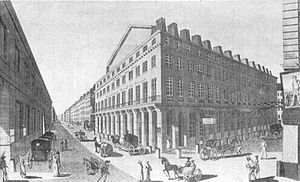
For these first new choreographers and dancers, challenges included creating ballets for the stage, rather than the private palaces of kings. A great new theater, The Paris Opera, was built, and turned over to Lully, by the king, for the express performance of these soon-to be-created works. These were to be for the amusement and edification of the public. Greater pomp and circumstance could not have begun or existed anywhere else, for perhaps no other king was so large-minded and extravagant, so despite Louis X IVs’ other reputation, we can thank him for the arts, for the theater and for the music, and for the dance and acting that were to come and have turned into the entertainment of ballet we see today. It has been a long journey, and an expensive one.
A technique called ‘ballet’ was then pronounced, a proscenium arch was created on the stage, to allow dancers to be seen from only one direction, causing them to move and pose in such a way as to give the audience a view only of only what was in front and turnout, among others affects, was established. Turnout, a principle long in use by now (since before the late 1500’s) was given a prominent position and fundamental emphasis in a dancer’s training-meaning the turnout of the legs at the hip joint. Whether it was known by now, or not, that some ballet movement could only be achieved this way, is really not that well documented, or important, but the logic was simple. A dancer, wishing to face his audience, needed to move sideways as well as forwards and backwards, and for even greater visibility, he needed to lift his leg to the side, rather than to the front. It does appear somewhat comical in engravings from the time, but this was taken very seriously, and for good reasons. These movements were more easily achieved when the legs were rotated outward. Choreographers who had created ballets for smaller rooms, with floor patterns for the dancers, now shifted their study to dances including vertical space and large spaces and theater. The dance of elevation was conceived.
Ballet had developed positions-five positions for the feet had been used by dancers for many years, but was now firmly established by Beauchamps, now the

ballet master, responsible also, for giving male courtiers the parts of female roles-they were masked or course! Female courtiers did not dance. He improvised Les Nopces de Pelee et de Thetis (The Marriage of Peleus and Thetus) on April 16, 1654, in Paris, at the Salle du Petit Bourbon, in the Louvre Museum, where a lot of similar early ballets were produced. It is a grand space. This was rather an opera plus dances and not strictly a ballet. But, here, nevertheless, ballet was not accidental, but integrated, as a parallel to the operatic action. Themes of a classical nature were acceptable to the court. There was almost always a subtext in the ballets of politics, through the libretto, and there is the assumption that the theater was created to expound and emphasize the true history or politics of the royalty in ballet as conceived by the aristocracy-or a new way to publicize their exploits and victories. This ballet boasted the defeat of the Fronde, daring Spain, a possible new threat, to risk war. However, the principle reason ballet survived in these performances was that the king wanted to dance, and so ballets were inserted between acts for him to do so. But, we can assume, in these lifetimes, that Beauchamps ingratiated himself to the king and that the technique of ballet was born for ordering these steps and making them memorable and pronounceable by the court, especially with reference to the king doing them, i.e., “your instep is lovely, your highness, in the first position”, and so on. The court learned these terms, almost before the dancers! Too bad today’s ballet audiences are not as eager to please! Also, these great productions would not have been possible without the finances of the King to promote them. The sets and machinery and transformations achieved by Giacomo Torelli (1608-1678) http://www.flickr.com/photos/42399206@N03/4331520565/, a designer who had a profound affect on stage space, was a scenic genius, and designer and engineer of these events: La Finta Pazza, Les Nopces des Pelee et de Thetis, and Les Facheux-were all glorious and legendary works, resulting in the king’s feeling the need of a theater to showcase them properly. Maybe the most magnanimous gesture in his royal history. According to decree by Louis XIV, the academie was started for the purpose of “reestablishing the art in its perfection.”
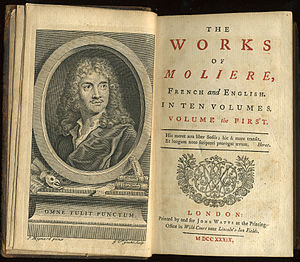
Also, in 1661, the king’s finance minister, Nicholas Fouguet, presented a grand fete to honor King Louis, in an opening of a summer palace. The housewarming’s entertainment was Moliere’s Les Facheaux, which qualifies as the first of the genre known as comedie-ballet. Favored, Moliere was employed by the king to develop the comedie-ballet further. The audiences had seen their comedies and their ballets separately. Now they could see the danced entrees that came between the play’s various acts as related to the playwrights scheme, rather than decorative diversions to cover the time actors needed to change costumes, although, these are still used today, even in ballets. So we have Lully, composer, Moliere, playwright, Baltarazini, Director/ballet master/violinist and Beauchamps, choreographer/dancer. As superintendent of the king’s ballets, in the 1661 dance academy, Beauchamps is the father of ballet. He is also the author of the now-codified ballet starter alphabet of the first five positions, and possibly arm positions. As the king was now aged, he quit dancing in 1670, which allowed these principles the freedom to expand, and reduced the risk of offending the king, by training and placing those more adept to take the leads in the productions.

By the late 17th century, women dancers had joined, but not superseded male dancers. When Lully died in 1687, of complications from stabbing himself in the foot with his own baton, the theatrical form of the Opera-ballet was popular. While similar to ballet a entree, these productions aimed for even more thematic and dramatic coherence. They included what we today would recognize as opera, which here served to introduce individual ballets, dances that elaborated on some individual overall theme, and brought more imagination to the table with less recitation and repetition. One writer, called the dances “beautiful Watteaus,” more like moving paintings. The librettist, Antoine Houdar de la Motte, identified them as “spicy miniatures demanding graphic precision, gracefulness of the brush and superior brilliant coloring.” He was of course referring to the entirety of the elements and not just the dancing. Andre Campa, who followed in Lully’s footsteps created the

opera-ballet, L”Europe Galante (1697). It was so successful that it marked the attendance of theater-goers, for the dance, for not only the music, but, maybe even more-the dance. To increase the popularity further, it was suggested by the composer, to lengthen the dances and shorten the skirts of the female dancers.

In 1700 , a description of of the art of French Court dancing for the theatre, as well as the ballroom, was written down in a book called, ” Choreographie, ou l’arte de descrire la danse”, by Raoul Auger Feuillet (1650?-1709?). The books characters, figures, and illustrative signs, were an early attempt to create a dance notation comparable to that for music. Choreographie spread around Europe and although a dance notation system was never universally recognized, it did give rise to other individual systems inspired by it. Beauchamps and Louis Pecourt (who succeeded Beauchamp after Lully’s death) co-authored the book, and are generally acknowledged as the source(s) for the steps contained therein. Later dance writers became ‘notators,’ but for the time being, choreography came from two words, (Greek) khorea-dance, and (German) graphein-write. Thus the English word, choreography. Thus, while the choreographer was the person who wrote the dances down on paper (like a stenographer), the teacher or ballet-master was the one who created them for the stage space (choreographer). These are two important differences, even today, as dancers learn technique only from the teacher, and are posed or arranged by the choreographer-so you can see it has changed completely. Well, not quite, but the ballet master or teacher, today, is frequently only seen as a teacher-perhaps one modern problem in today’s ballet society. By the early 1700’s ballet schooling was largely already in place, and some of Feuillet’s terms are slightly different than today’s. Some choreographers (and teachers) use the same names to distinguish somewhat different movements. Today’s jete (a jump move instigated by a thrown foot), sissone (a jump off two feet landing on one, named after Msr. Sissone), chasse (a step with one foot chased by the other), entrechat (a jump move to “weave” the feet in the air), pirouette (a whirl or spin in place), and cabriole (a jumped
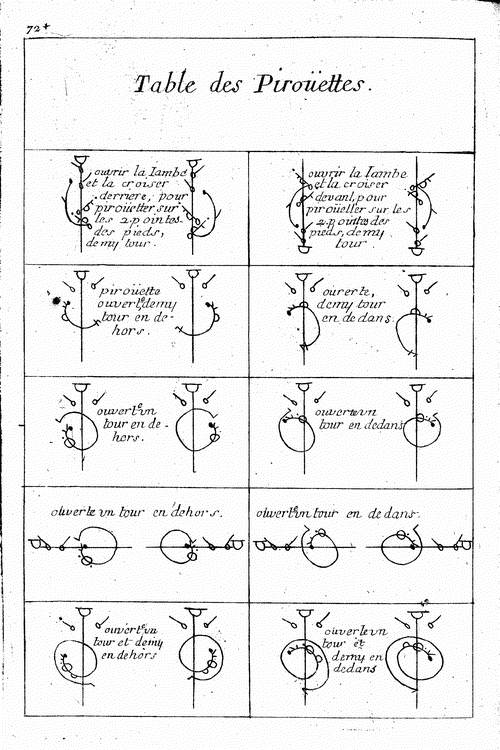
caper with the legs briefly closing and opening again in the air). All of these remain much as they were in Feuillet’s time, however, jetes are called ‘degages’ and ‘jetes’ by Vaganova students, (also ‘entrelaces’) and ‘tour jetes’ by Italians and Americans (such as Cecchetti and Balanchine students). Sissones are generally always called sissones by everyone and chasses as well. Entrechats constitute: entrechat quatre, entrechat trois, entrechat six (6 beats), and others, although there is some dispute as to whether the beat itself is counted or also the opening (as two). Semantics aside, the movement are similar, but the nuance and gesture, including epaulment does almost certainly vary by school. In most techniques, these are virtually the same, but degage turns (Vaganova) are called lame ducks (RAD). Some teachers will call the pas de chat, grand pas de chats, saute chat, or grand jetes, depending on the teacher (er, ballet master and choreographer). There are many differences in dancing terms, but more particularly the name of the move(s) associated with it, multiples and extensions of it, depending on the way the person explaining it learned it, and in some schools, they might just say, “Turn”. This is even more difficult to write, much harder to interpret, impossible to remember unless witnessed and demonstrated, and is a prime reason for learning to notate your own dances! Maybe more from history would exist accurately, if we could unravel it. Beyond that, we would have to agree. Some of these terms, were specifically excluded from ballroom (or social) dancing eventually, and were reserved especially for ballet dancers, or those with more training to execute them properly, but these dictionaries, you see, only represent a fraction of the meaning or possible meanings.
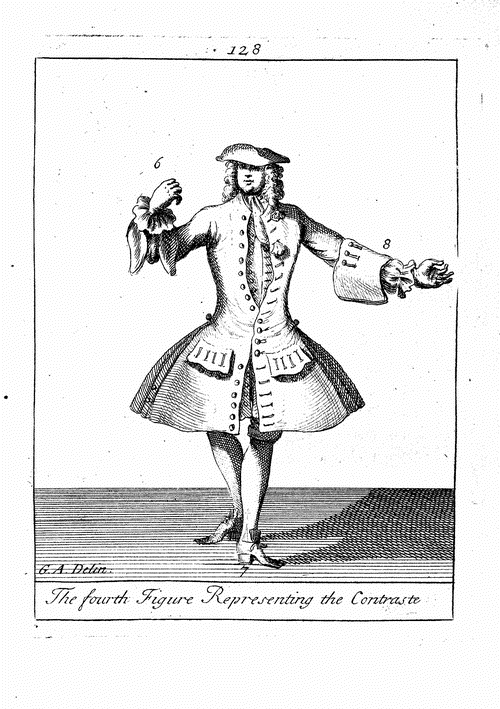
Danse d’ecole came to not only represent the school of dancing, but the body language associated with it demonstrated by the students of it. Whew! It also serves as a synonym for ballet dancing in general. So after, you believe you know everything about ballet, you find you really know nothing with certainty at all. Though Feuillet’s writing included working from the five positions of the feet credited to Beauchamps, it was not until The Dancing Master (1725) by Pierre Rameau (1674-1748), a social dancing manual, was published, that they were formally documented and credited to Beauchamps. Rameau was dancing master to the Queen of Spain.


 mysylph