NYC Ballet’s Amar Ramasar on Alexei Ratmansky’s PICTURES AT AN EXHIBITION – YouTube.
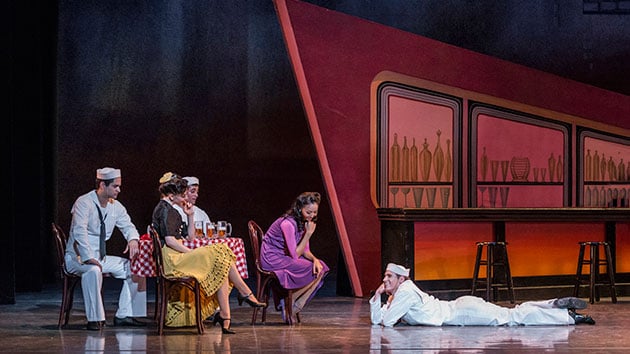
Fancy Free, whose company premiere Friday highlighted Ballet San Jose Silicon Valley’s first repertory series, would seem a natural for the troupe. Now a close ally of American Ballet Theatre, its artistic director, stellar ABT alum Jose Manuel Carreno, was known for his macho participation in Jerome Robbins’ classic romp about three sailors on shore leave, the bones of which were to lead to the smash musical On the Town, now in Broadway revival, and thence, via Gene Kelly and Frank Sinatra, to the movie version and immortality.
Fancy Free, created when Robbins was still dancing with Ballet Theater, remains one of his greatest works, also paving the way for landmarks by its young and brilliant composer, Leonard Bernstein.
So entertaining, debonair and practically perfect was Friday’s performance that what it took to get it on its feet might well be left in the dust. That would be a shame. Robbins, for all his genius, was never a fancy-free choreographer, and without the precision he dictated, from inception through its passage from Ballet Theater, as the company wasthen called, down to the present, when it remains a staple of the New York City Ballet, ABT, and dozens of fortunate troupes around the world, Fancy Free would be oh, less than nothing.So entertaining, debonair, and practically perfect was Friday’s performance that what it took to get it on its feet might well be left in the dust.
But, like most great choreographers, Robbins left orders in place to guarantee that his work would be staged the way he wanted it staged. We also see this, of course, in the work of George Balanchine and Twyla Tharp among many others; both of them were also represented Friday in Theme and Variations, a BSJ standard, and In the Upper Room, which joined the rep last year.
The way staging happens is in part through the sharing of dancers’ physical and performance recollections – dance being very much a “body to body” art form, as Edward Villella says – as well as film and notation (and pointed remarks) directly from the creator. So the stagers for these three ballets, designated by the respective artists and their trusts, worked with Ballet San Jose’s dancers to make everything the way it ought to be. They were (Fancy Free) Philip Neal, who danced for Robbins when he was co-ballet master-in-chief (whew) at the New York City Ballet; (Theme and Variations)Sandra Jennings and Stacy Caddell for the George Balanchine Trust, also at City Ballet, and (In the Upper Room) two former Tharp dancers, the great Shelley Washington, and Gil Boggs (now Colorado Ballet’s artistic director).
Of the three, Fancy Free was the standout, rising way above the tinny, taped music (Ballet San Jose, still woefully short of funds, could not reach an agreement for the services of Symphony Silicon Valley). Richly nostalgic with its angular Oliver Smith bar-room set design and Bernstein’s score, its keen rhythms evoking his fascination at the time with things Latin, plus the entire notion of carpe diem or, dare we say, dame – it was, after all, shore leave in the middle of World War II; everything, particularly the rhumbas, the moments of boyish brooding, the fights, the flirts, the resilience, the friskiness of the chase, all of it came together at the San Jose Center for the Performing Arts so precisely, with fine technique and such wonderful, readable nuance.
In the small cast, the great performances abounded: Rudy Candia, Walter Garcia and Joshua Seibel as the gobs; Grace-Anne Powers and Ommi Pipit-Suksun as their leggy quarry, and, in smaller roles, Emma Francis as a last-minute distraction, and James Kopecky as the long-suffering bartender.
Theme and Variations, all satin, tutus, Tchaikovsky (Suite No. 3 for orchestra) and chandeliers, went off without many hitches, though this taxing and stunning opener needed a few moments for the company to hit its stride. In the leads, principal dancers Junna Ige and Maykel Solas were prodigies of durability and grace, drawing in all viewers for the central ballet, Balanchine’s wonderfully intimate, tender yet frolicsome pas de deux.
Again, not to beat a dead horse, this company desperately needs, absolutely requires, live music. I can’t think of a ballet company that doesn’t. The likely exception would be for In the Upper Room, whose Philip Glass score might really demand the ministrations of a full-time and totally unaffordable company orchestra. On Friday, the audio sounded as good as anyone else’s, which isn’t really as grudging as it sounds, if you love Glass as much as this viewer.… this company desperately needs, absolutely requires, live music. I can’t think of a ballet company that doesn’t.
As noted here before, this – thanks in no small part to Glass – is one of the great creations of Tharp or anybody else. It flies by, and the minute it’s over, you want it all again. Is it the dry-ice fog, the lights, the Norma Kamali black-and-white prison pj’s contrasted with red tops and toe shoes, or white sneakers and shirts? Nah. It’s Twyla, first, last and always. Nobody has ever pointed up as viscerally what it means to dance and perform, in so many ways, as she does. (Oh, we could perhaps argue that her Push Comes to Shove is equally brilliant in this argument, plus it came equipped with Mikhail Baryshnikov at its premiere. But no.)
At any event, Ballet San Jose, even on its uppers, gets and represents In the Upper Room to the marrow of its bones. This company needs – and all of us need it – to keep on dancing.

https://www.operadeparis.fr/videopera/les-danseurs-etoile-du-ballet-de-l-opera-de-paris
REPOSTED FROM THE AGE/JOEL MEARES
Harrison Lee, 15, back home in Castle Hill after winning the famed Prix de Lausanne. Photo: Steven Siewert
At first, Harrison Lee thought he was in trouble. His mother had called him into her bedroom early in the morning, and he was “a little scared” – this was not the regular morning routine at their Castle Hill home. Then she gave him the news: “She sat me down on her bed and said, ‘Congratulations, you’re going to Switzerland!'”
It was the news the 15-year-old had been waiting more than a month to hear, ever since he sent a DVD of himself performing a variation from the ballet Flames of Paris to the judges of the Prix de Lausanne, among the world’s most prestigious competitions for young dancers. From 300 entrants, he was one of 70 invited to Lausanne, on the shores of Lake Geneva, for a week of classes and performances.
“When she told me I got in, happiness just took over my body,” says Lee. But he did not leap down the road, Billy Elliot-style, painting his delight for the world in pirouettes and arabesques. “I’m not one to scream and shout and go crazy,” he says calmly. “It just took over inside.”
Harrison Lee: The dancer won the Youth America Grand Prix in 2014. Photo: Steven Siewert
Last week, after eight days of classes and major performances, Lee took top prize in Lausanne. He again showed trademark control when called forward from a line of finalists – some three and four years his senior. “I was shocked, and I was getting very emotional so I had to hold that in until it was over.” He adds with a laugh: “I didn’t want to watch this back five years later and see myself crying.”
Advertisement
The Lausanne win comes just shy of a year since Lee took out the equally prestigious Youth America Grand Prix: the one-two punch puts him among the most promising, and prized, young dancers in the world. Watching the YouTube video of Lee performing his classical variation at the Lausanne finals – a video that has clocked 37,000 views in less than a week – it is easy to see why. His control and strength astounds: he springs to impossible heights from the raked stage; his toes arch improbably towards his heel. One commenter writes under the video: “Good lord those feet are so good they should pay taxes!”
Brisbane’s Lucid Dance Theatre founder Louise Deleur was a choreographer at the Prix, and watched Harrison on stage and in classes, where the dancers are also scored. “He was blessed with these long legs and beautiful feet,” says Deleur, “but what also stood out about Harrison was his humility and graciousness in class. He’s a beautiful soul to work with.”
Lee spent a week in London before the competition taking classes at the Royal Ballet School. He did some sightseeing – Harry Potter World, even though he’s not a great fan of the boy wizard – but mostly it was business. It’s the same at home: he takes two hours of ballet every day at the McDonald College, and three more hours every day after school. His diet “is not as strict as the girls” but he watches what he eats. He points out, humbly, that teachers Josephine Jason, Jane Kesby and Allan Cross have sacrificed as much as he has for his success.
The goal, Lee says, is to become the principal dancer at a company so that “I can dance as many lead roles as I can”. He’s not being unrealistic. Following his successful 12 months, Lee now has his choice of schools: by September he will be living in New York and attending the American Ballet Theatre, or in London at the Royal Ballet, or anywhere else he chooses to attend in Europe. Recruiters are clamouring.
“It’s weird to think at 16 I will be on the other side of the world, living by myself and cooking and cleaning and washing up,” says Lee. “It’s scary, but it’s what I’ve been training for.”
For mother Cindy, a travel agent, the prospect of Harrison moving is bittersweet. The family delights in his success – his brother skipped schoolies to go to Switzerland and watch Harrison compete; Cindy gets giddy recalling how Li Cunxin (of Mao’s Last Dancer fame) told her he was looking forward to seeing her son dance.
“But it’s sad too to think of your child travelling so far away at such a young age,” she admits. “A lot of people probably don’t understand it – people who don’t have a child with a passion or dream and the talent don’t understand how you could see your child do that. We’re happy to see him reach his goals.”
And wherever Lee lands, mum will be visiting. A lot. “It will be a path well worn, I imagine,” she says.
via Ballet dancer Harrison Lee wins prestigious Prix de Lausanne prize.
REPOSTED FROM DANCING TIMES
Millepied’s plans for the Paris Opéra : Wednesday, 04 February 2015
Benjamin Millepied has announced plans for the 2015–16 season of the Paris Opéra Ballet, the first he has programmed as director. It’s an ambitious season, with many new works, including one by new associate choreographer William Forsythe and a new production of The Nutcracker, to be choreographed by Arthur Pita, Sidi Larbi Cherkaoui, Liam Scarlett, Edouard Lock and Millepied.
Millepied announced his season alongside Stéphane Lissner, who has been general director of the Opéra since July 2014: the two leaders promise a new level of cooperation between the ballet and opera companies. The new Nutcracker will be performed as a double bill with Tchaikovsky’s opera Iolanta – as these works were performed together at their premiere in 1892. The five choreographers will create separate scenes for the new production.
Millepied has also commissioned new works from Justin Peck, Wayne McGregor, Jérôme Bel and himself. Peck’s work will be danced to Poulenc’s Concerto for Two Pianos and Orchestra, with designs by artist John Baldassari. McGregor’s piece will be set to Pierre Boulez’s Anthème II as part of an evening celebrating the composer.
Millepied, who danced at New York City Ballet (NYCB) from 1995 to 2011, brings an American slant with some of his programming. The season will include Balanchine’s Theme and Variations, Duo Concertant and Brahms-Schönberg Quartet, Jerome Robbins’ Opus 19/The Dreamer, Goldberg Variations and Other Dances. Justin Peck, the resident choreographer at NYCB, is represented by In Creases as well as his new commission; Christopher Wheeldon’s Polyphonia, created for NYCB, also joins the repertoire. The season will also include company premieres by Anne Teresa De Keersmaeker, Alexei Ratmansky and Maguy Marin.
There are just three evening-length revivals: Giselle and Rudolf Nureyev’s productions of Romeo and Juliet and La Bayadère. There will also be works staged in the foyer of the Opéra Garnier. Choreographer Boris Charmatz will stage a new event to open the season, with 20 dancers performing solos from the 20th-century repertoire in the public spaces of the Opéra Garnier.
Millepied and Lissner also announced a new digital platform, “3e Scene”, or “Third Stage”. Hosted on the Paris Opéra website, this will present new work by composers, choreographers, directors, visual artists, filmmakers and writers. There will also be a new Paris Opéra Academy, which will offer residencies to young choreographers from inside and outside the company. The choreographers will be mentored by William Forsythe. Millepied told the New York Times that the academy aimed to teach dance-making as a craft. “We won’t necessarily discover more geniuses, but there will be more competence,” he said. “Composers learn the principles of harmony, counterpoint, technique, and choreography is no different.”
Millepied has also announced touring plans, and works scheduled for later seasons. The company will visit one French city each season, touring to Brest in the 2015–16 season. Major tours to the US are being planned. Guest companies at the Paris Opéra will include Anne Teresa De Keersmaeker’s Rosas, Batsheva Dance Company and English National Ballet, who dance Le Corsaire at the Opéra Garnier in June 2016.
Looking ahead, Millepied has commissioned an evening-length work from Alexei Ratmansky for the 2016–17 season. He also expects to schedule some work by the iconic modern dance choreographer Merce Cunningham. At the press conference, critic Laura Capelle reports, Millepied explained that he had almost left NYCB to dance for the Cunningham company.
Performances for the Paris Opéra Ballet’s 2015-16 season are now on sale.
Picture: Benjamin Millepied at the Opéra Garnier. Photograph: Julien Benhamou
Starring Plisetskaya, Carmen Suite, is Cuban choreographer Alberto Alonso’s ballet in one-act set to music by Plisetskaya’s, husband and composer, Rodion Schedrin (Russian). First choreographed in 1967, this enduring version is available on YouTube (below) and features Alexander Godunov, as well.
Bizet’s melodies are modernized with percussion, faster rhythms, and new color, heightening the effect of the instrumentality and choreography, which in turn violently accents the music’s rhythms and sharpens the senses, underlining the theme. There is an almost artwork-like approach to parts of the choreography-my favorite is the bull. The stark scenery, almost hell-like coloring and pit appearance of the walls, use of red and lighting, devil innuendo, slithering movements which contrast with the doll-like movements of Maya’s legs, Godonov’s solo is particularly moving in the bright yellow shirt, mocking his tender feelings, and making him appear the clown in love. The costumes, and lighting, creation of sharp contrasts in the choreography, movement between dark and light, black lines, and even the shadow-like manifestations of fates, bulls, and the watchful eye of the police in silhouette, which draws the viewer in on many possible different levels, sequence of the movement of film, impossible on stage alone, make this a most interesting use of cinematography and art in film and ballet. In a surrealist way, Maya is content to sit back, predatory almost, watching, while these other themes are played out, though all the while remaining the object of desire which results in the story being told in a sort of “round”, as the scenery suggests, and as in comedy, timing is given very practical and followable use here. Like a clock or time, in a sometimes whirlwind way the hand plays out, and the camera circles in much the same way, all in a dance. Many different things are going on at once, creating a higher sense of drama and a sense of urgency. Initially banned by the Soviet hierarchy as “disrespectful” to Bizet, the opera, and the ballet, it has since become Shchedrin’s best-known work and is more frequently attempted by companies, perhaps one of the only ballets which works better on film. Of particular interest is the fact that the artful components, and Plisetskaya’s natural understanding of how to play the role, not focusing as much on the dance, or acrobatics of it, but rather on the subtlety of the “less is more”, fine acting, upper body and expression, leaving a mystique to Carmen’s possibilities unlike any other, but also supporting the version of one of the readily available and best examples from the period of modern choreography with clear story-telling. Several other “stars” have attempted it on stage, but I like this version best. Another favorite, for other reasons, is Alicia Alonso’s version http://youtu.be/SEOmKbvHT_U which is a bit more Spanishy, perhaps, and simpler, but she is just a wonderful and physically expressive dancer. Some people prefer her version of it.
Uliana Lopatkina’s version http://youtu.be/5Zie4d4MbGo is a successful “copy” of it (in some senses), but the choreography is reworked to highlight Lopatkina’s assets, rather than focusing on the story and the original choreography, though able to be performed by her technically, it just does not resonate with me at all. Perhaps a case where Maya’s more sprightly and lightning quick abilities while moving, due to her small size, give her sufficient time to wait, pause and act. Despite Lopatkina’s obvious talents and abilities, this is perhaps not the best piece for her due to height. However, disappointingly, the full version of it is not available online, just a scene from the habanera. I am sure she is good-it would be so much better if it were, probably. Maria Alexandrova’s more recent version http://youtu.be/h8VUfO-3G4o is also pretty good, but I do not see the control or maturity in her movements in it that Maya possesses and what the heck, it’s wonderful, but not the same (to me). That version is also available for comparison below.
BIG news! Please share…
HARID Conservatory Announces $25,000
Marcelo Gomes Scholarship Program
The HARID Conservatory recently announced an exciting new initiative to support the training of male dancers. The Marcelo Gomes Scholarship Program will provide a number of qualified finalists the opportunity to attend HARID’s four-week Summer School on full scholarship. During the Summer School, they will compete for a grand prize: the Marcelo Gomes Scholarship. The Scholarship will support the winner’s continued studies at the school during the 2015–16 academic year.
Each of the Program finalists will receive an award valued at $3,200 to cover his tuition, room, and board at HARID’s Summer School. The Marcelo Gomes Scholarship, valued at $6,000, will offset the winner’s fees for room and board during the academic year. (All students study tuition free at HARID during the academic year.)
HARID director, Gordon Wright, stated, “We are pleased to name this new scholarship initiative in honor of Marcelo Gomes, one of HARID’s most-distinguished alumni. Marcelo has enjoyed an esteemed career as a principal artist with American Ballet Theatre in New York City. He is revered worldwide for his technical expertise, artistic sensibility, and his exceptional abilities as a partner. Being named the winner of a scholarship bearing Marcelo’s name will be a tremendous honor and a feather in the cap of any young male dancer.”
Male dance students 13–16 years of age are invited to apply to the Marcelo Gomes Scholarship Program by attending a HARID Summer School audition in January or February (www.harid.edu/auditions), or by submitting an electronic application on or before February 15, 2015. Electronic application requirements include a video presentation of class work and a personal statement. Visit www.harid.edu/marcelo-gomes-scholarship for details. The finalists will be selected by a jury comprised of HARID’s director and ballet faculty. The winner of the Marcelo Gomes Scholarship will be announced at the conclusion of Summer School.
………………………………………
Marcelo Gomes left his native Brazil at age fourteen to enroll at The HARID Conservatory. While a student at the school, he competed at the Prix de Lausanne international ballet competition. There, he was awarded the Hope Prize in recognition of his significant potential. After graduating from HARID, Marcelo spent an additional year studying at the Paris Opera Ballet School and was then asked to join American Ballet Theatre. He was soon promoted to soloist and, just two years later, he was made a principal dancer of the Company.
Most balletomanes know that Marcel Gomes was (in part) a product of the famed Harid Conservatory in FL, and the prodigal son has returned to endow the school with the well-spent fund in hopes of assisting male dancers to their dreams of becoming ballet dancers. This is an amazing endowment (from a dancer). Called putting your money where your mouth is….call it a LEAP of faith. They are very happy and would appreciate a SHARE-
HARID Conservatory Announces $25,000
Marcelo Gomes Scholarship Program
The HARID Conservatory recently announced an exciting new initiative to support the training of male dancers. The Marcelo Gomes Scholarship Program will provide a number of qualified finalists the opportunity to attend HARID’s four-week Summer School on full scholarship. During the Summer School, they will compete for a grand prize: the Marcelo Gomes Scholarship. The Scholarship will support the winner’s continued studies at the school during the 2015–16 academic year.
Each of the Program finalists will receive an award valued at $3,200 to cover his tuition, room, and board at HARID’s Summer School. The Marcelo Gomes Scholarship, valued at $6,000, will offset the winner’s fees for room and board during the academic year. (All students study tuition free at HARID during the academic year.)
HARID director, Gordon Wright, stated, “We are pleased to name this new scholarship initiative in honor of Marcelo Gomes, one of HARID’s most-distinguished alumni. Marcelo has enjoyed an esteemed career as a principal artist with American Ballet Theatre in New York City. He is revered worldwide for his technical expertise, artistic sensibility, and his exceptional abilities as a partner. Being named the winner of a scholarship bearing Marcelo’s name will be a tremendous honor and a feather in the cap of any young male dancer.”
Male dance students 13–16 years of age are invited to apply to the Marcelo Gomes Scholarship Program by attending a HARID Summer School audition in January or February (www.harid.edu/auditions), or by submitting an electronic application on or before February 15, 2015. Electronic application requirements include a video presentation of class work and a personal statement. Visit www.harid.edu/marcelo-gomes-scholarship for details. The finalists will be selected by a jury comprised of HARID’s director and ballet faculty. The winner of the Marcelo Gomes Scholarship will be announced at the conclusion of Summer School.
………………………………………
Marcelo Gomes left his native Brazil at age fourteen to enroll at The HARID Conservatory. While a student at the school, he competed at the Prix de Lausanne international ballet competition. There, he was awarded the Hope Prize in recognition of his significant potential. After graduating from HARID, Marcelo spent an additional year studying at the Paris Opera Ballet School and was then asked to join American Ballet Theatre. He was soon promoted to soloist and, just two years later, he was made a principal dancer of the Company.
Gomes was named one of “25 to Watch” by Dance Magazine in 2001. In 2008, he was awarded the prestigious Benois de la Danse following a performance of Lar Lubovitch’s Othello in Moscow. Marcelo has performed at numerous international dance festivals and as a guest artist with many companies, including the Kirov Ballet, the Bolshoi Ballet, Dutch National Ballet, Mikhailovsky Ballet, The Royal Ballet, National Ballet of Canada, Teatro Colón in Buenos Aires, Teatro Municipal do Rio de Janeiro, and the New York City Ballet.
Marcelo has recently begun a successful career as a choreographer while maintaining his schedule as one of classical ballet’s most sought-after male dancers.
2015.
Darcey Bussell dazzles in elegant Audrey Hepburn documentary – and gets Twitter in a spin
Dec 30, 2014 11:47
By Kara O’Neill
The Strictly Come Dancing judge proved to be a hit as she delved into the glamorous actress’s life and the secrets of her past.
Darcey Bussell is already a firm favourite on primetime telly, and her latest venture in the land of showbiz has made her even more popular.
The former ballerina, who is also known as a Strictly Come Dancing judge, was a hit on Monday night with her documentary Looking For Audrey.
Delving into the past of glamorous film star Audrey Hepburn, Darcey stepped back in time to uncover the truth about the actress behind the glitz of a Hollywood smokescreen.
Paying visits to locations all around the globe that played an important part of Audrey’s life and career, Darcey discovered how she started as a dancer, risked her life in the war, and was often a lonely individual looking for true love.
But while Audrey’s past swept enthralled viewers along quite nicely, it seems that Darcey’s softly softly presenting style and her clear passion for her idol really shone through.
Twitter users were suitably impressed with her performance with one writing: “Brilliant, Darcey. Do more. You both sparkled!”
This could be just the beginning for Darcey, who also made her name as a dancer.
The 45-year-old trained at the Royal Ballet School before going on to have a long career in The Royal Ballet.
She is most widely know now as a judge on BBC One show Strictly Come Dancing, when she joined the panel in 2012.
Speaking to the Telegraph about her idol, Darcey admitted she had been obsessed with Audrey and her life from a very young age.
“She has inspired and intrigued me since I was about 10.
“She was always very real, one of those natural stars who never tried to be anything other than who she was. It’s hard to stay true to yourself and it’s rare, especially today.”
*Catch up on Darcey Bussell’s Looking For Audrey on BBC iPlayer

 mysylph