Ballet San Jose Silicon Valley succeeds with ‘do-or-die’ fundraising effort
By Karen D’Souza
POSTED: 03/16/2015 06:00:07 AM PDT# COMMENTS| UPDATED: A DAY AGO
Ballet San Jose Silicon Valley successfully overshot its do-or-die fundraising goal over the weekend by almost $100,000. Many see it as a much-needed shot in the arm for the valley’s fragile art scene.
“The community does not want to lose another arts organization,” said Lisa Mallette, head of City Lights Theater Company. “People are willing to step up and ensure that this one remains strong and vital.”
The South Bay’s major resident dance company snagged $640,000, more than the $550,000 it needed to stay alive. With the emergency push behind it, ballet leaders said they intend to reboot its operation, including rebranding it: Silicon Valley Ballet.
Corps de Ballet members, from left, Alison Stroming, Grace Anne Powers and James Kopecky, practice during a company class taught by San Jose Ballet Artistic Director José Manuel Carreño, at Ballet San Jose in San Jose, Calif. on Tuesday, Jan. 14, 2014. (LiPo Ching/Bay Area News Group) ( LiPo Ching )
“This campaign proves that people care about the ballet as much as we do and it gives us the ramp we need to get out ahead of the situation,” said ballet CEO Alan Hineline. “Finally there is some good news for the arts in the South Bay. We believe the ballet can be a rallying point for the city and the downtown.”
Withhttp://extras.mnginteractive.com/live/media/site568/2015/0310/20150310__SJM-BALLET-0311~1_300.JPG many in the arts community still reeling over the loss of San Jose Rep, the fact that the ballet stayed afloat is the source of great relief. It was also seen as a vote of confidence that the valley, often knocked as an industry town interested only in high tech, also values the arts.
TEETERING ON THE EDGE
It’s also a refreshing outcome because it comes after a series of devastating losses in recent years.
Corps de Ballet members, from left, Alison Stroming, Grace Anne Powers and James Kopecky, practice during a company class taught by San Jose Ballet Artistic Director José Manuel Carreño, at Ballet San Jose in San Jose, Calif. on Tuesday, Jan. 14, 2014. (LiPo Ching/Bay Area News Group) ( LiPo Ching )
The region has lost not only the Rep, which went under last year, but also Shakespeare Santa Cruz, which died in 2013 (before being reincarnated in a smaller form) and American Musical Theatre of San Jose, which perished in 2008.
Hineline, for one, has been pushing hard to buck the trend of local arts groups teetering on the edge.
“We know that the collapse of the Rep hurt everyone. A loss like that sends shock waves,” Hineline said. “We wanted to change that narrative, to change the ending of that story — and we did. Finally there is some good news for the arts in the South Bay.”
So, what made the ballet better positioned for survival than the Rep, which was also a beloved local institution?
One of the smartest moves the ballet made may have been making a public appeal over its fate, instead of slipping away quietly.
“The Rep went under without a word, which upset a lot of people,” said Andrew Bales, head of Symphony Silicon Valley. “The ballet made some noise and gave people a chance to have their say.”
Of course, this could be just a temporary reprieve. Ballet leaders must stay on their toes because there is another deadline looming. Company officials say they will need to raise $3.5 million by October to restructure the company’s business model and re-brand itself as Silicon Valley Ballet. The troupe, now led by ballet hotshot Jose Manuel Carreno, wants to raise its profile and reach out to a wider geographic audience.
SHORT HISTORY
The troubled company, which partnered with New York’s American Ballet Theatre in 2012, has weathered many fiscal crises over the years. Old debts have piled up, including a $500,000 tax bill, and the company’s biggest patron, John Fry, CEO of Fry’s Electronics, dialed back his patronage. The ballet has countered by cutting back, scrapping some performances and dropping live music accompaniment here and there. The budget for the organization, which includes 32 professional dancers and bustling school of 350 students, now stands at $5.6 million, down from a high of $8 million.
One of the most frustrating aspects of the harsh South Bay arts economy is the comparative wealth of groups in San Francisco and Berkeley. Yet local arts honchos suggest these struggles may simply be growing pains.
“The San Francisco art scene was built over 150 years, seeded in the Gold Rush,” said Randall King, head of San Jose Stage Company. “South Bay cultural resources have a relatively short history. We have built a competitive environment in a very limited timeline. We are younger, but no less valid or viable.”
José Manuel Carreño adjusts Ommi Pipit-Suksun in company class. Photo by Alejandro Gomez
Ballet San Jose Needs $550,000 To Stay Afloat
Posted by Kristin Schwab on Friday, Mar 06, 2015 (reposted from Dance Magazine)
Ballet San Jose announced this week that it must raise $550,000 by March 14 to keep its doors open.
The company has a troubled past when it comes to leadership and funding. For instance, it sought out loans to help cover what critics more or less dubbed as over-ambitious seasons during the final decade of artistic director Dennis Nahat’s leadership. In 2013, former American Ballet Theatre dancer José Manuel Carreño was appointed AD. As we reported in our January 2014 feature, during his first season, the company’s prospects were looking up. Though Carreño had little to no experience running a company, his fame helped donations rise during the 2012–13 season and Ballet San Jose nearly broke even, compared to a $1 million operating loss in the previous year.
In a press release, BSJ said that if it is open come September 2015, the company will rebrand itself as Silicon Valley Ballet—a move to more closely identify itself with the neighboring tech community.
Photo Flash: First Look- Atlanta Ballet’s World Premiere Ballat Adaptation of Tennessee Williams’ CAMINO REAL
February 27
3:36
2015
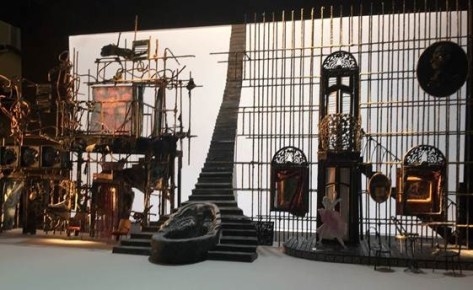
This spring, Atlanta Ballet will present the world premiere of a ballet based on “Camino Real” by Tennessee Williams, the renowned playwright who authored such American classics as “A Streetcar Named Desire” and “Cat on a Hot Tin Roof”. Choreographed by Atlanta Ballet choreographer in residence Helen Pickett, Williams’ “lost classic” of love, redemption and courage will debut March 20-22 at the Cobb Energy Performing Arts Centre. Check out pictures and renderings from the show below!
Inspired by Williams’ 1953 Broadway play of the same name, the story is told from the perspective of Kilroy, a character based on patriotic iconography from the WWII era. The young American soldier and onetime prizewinning boxer finds himself trapped in the surreal, dead-end town of Camino Real forced to grapple with mortality, the burning desire to connect and the will to live.
Through his journey to bring renewed hope to the town of lost souls, Kilroy meets a cast of unlikely characters from various periods of history and pop culture, such as Casanova, Esmeralda (The Hunchback of Notre Dame), Marguerite (The Lady of the Camellias), and Lord Byron, who together struggle to escape their fates.
“This is your classic good versus evil story,” said Pickett, whose adventure with the play began five years ago when her father handed down his copy from his college theater days, suggesting it would make a good ballet.
“I read it once and put it away, not understanding how I might tackle the content,” said Pickett. “A year later, I picked up the play again, and found my way into the story: focus on the characters first. Now, it is such a part of my reality, I can’t imagine how I will let go of these characters.”
Pickett announced the project shortly after accepting her residency with Atlanta Ballet in 2012 and has been working on the production ever since. Every aspect of the ballet, from the music to the costumes to the set design, has been a collaborative effort between Pickett and the team of artists she assembled.
To design the whimsical costumes, Pickett chose award-winning designer Sandra Woodall, who she has known since her days as a student with San Francisco Ballet. Woodall then introduced Pickett to lighting designer David Finn, whose commissions include Cirque du Soleil and numerous other major U.S. ballet companies. Finn then recommended set designer Emma Kingsbury, who he subsequently worked in tandem with on the scenic design. The rich, textured score, which Pickett has described as a character all its own, is the creation of composer Peter Salem.
“All of these people truly enjoy the art of collaboration,” said Pickett. “They are magnificent artists that bring all their ideas to the table. We are like mix masters; we just throw all of our concepts into the bowl and stir and filter. I am in love with each of them and their visions.”
The final layer of the creative process was the choreography- a collaboration as well with Atlanta Ballet’s full 23-member company. Pickett began working with the Company in September, devoting full days to rehearsal to ensure that the 75-minute ballet would be complete by its March premiere. By opening night, more than 300 rehearsal hours will have gone into bringing the production to stage.
To add to the theatricality, Pickett has also challenged several of the dancers to learn lines. Williams’ text – actual excerpts from the play – will be spoken by the principal characters throughout the ballet.
“It’s a new situation for them,” said Pickett in a 2014 interview with Creative Loafing. “But they are opening and unfolding in incredible ways. I wouldn’t have asked them to do this the first time we worked together. You have to build trust between you and the performer so that a person feels like they can open up, so cracks can happen in those walls, maybe even a breakthrough can happen.”
Atlanta Ballet’s world premiere of “Camino Real” will open at the Cobb Energy Performing Arts Centre on Friday, March 20 with a red carpet opening night. Three performances will follow, including the finale on Sunday, March 22.
Tickets start as low as $20 and are on sale now. To purchase tickets, visit http://www.atlantaballet.com or call 404-892-3303. For groups of ten or more, call Atlanta Ballet Group Sales at 404-873-5811, ext. 207.
Artistic Director and principle dancer Tamara Rojo & Fabian Reimair from English National Ballet rehearse Akram Khan ‘s new work: Dust, as part of a program entitled ‘Lest We Forget’ in commemoration of the start of World War I, at The Barbican Centre in London Photo: Araud Stephenson
Tamara Rojo: Axing dance in schools will restrict ballet to wealthy
Tamara Rojo, the artistic director of the English National Ballet criticised the decision of former education secretary Michael Gove to cut dance from the school curriculum
Artistic Director and principle dancer Tamara Rojo & Fabian Reimair from English National Ballet rehearse Akram Khan ‘s new work: Dust, as part of a program entitled ‘Lest We Forget’ in commemoration of the start of World War I, at The Barbican Centre in London Photo: Araud Stephenson
By Keith Perry 11:47PM GMT 05 Dec 2014
Tamara Rojo, the artistic director of the English National Ballet has criticised the decision of former education secretary Michael Gove to cut dance from the school curriculum, saying it risks making dance a preserve of the better off.
Ms Rojo said it was unfair as it meant “those that don’t have the means won’t have access to dance”.
She told the Evening Standard that is was particularly unwise to take dance out of schools as there was evidence of overwhelmingly improved results in maths taught through movement and 100 per cent increase in confidence.
The ENB itself offers tickets for as little as £10 to enable people to enjoy live dance. “We try to ensure that it is an art form that is accessible to everybody,” she said.
The Spanish dance star and her company are preparing to open their traditional Christmas production of Nutcracker followed by a run of Swan Lake.
Rojo said Nutcracker was important because the company had been performing it for more than 60 years. She added: There are two dozen Nutcrackers going round the United States. it is a very important tradition because for so many people it’s the first time they come to see ballet at all or to see a live performance in an orchestra.
“It’s a family tradition that goes from generation to generation and serves as an introduction to the art form.”
The challenge, she said, was to keep those first-time visitors – but audiences for dance have been growing. She praised both Billy Elliott, which overturned many prejudices about boys doing ballet, and Strictly Come Dancing for helping to foster a new passion.
But she rejected any notion she might follow Darcey Bussell in becoming a judge on the BBC show saying: “I think Darcey does a wonderful job.”
Rojo, 40, boosted the ENB’s fortunes when she returned as principal and boss two years ago but she said the pressure was shared with the arrival of major dancers such as Alina Cojocaru and guests including and guests including Ivan Vasiliev.
But she warned she would not be able to dance for as long as Sylvie Guillem who will retire next year at 50.
“She has an incredible physicality that I sadly don’t have. My end will come much earlier than that.
The Nutcracker runs at the London Coliseum from Thursday to January 4.






 mysylph