Category Archives: Ballet Chicanery

Part 2 of Winning the War Against Fat: The Emergent Sylph


//www.googletagmanager.com/ns.html?id=GTM-5DBTHW
(function(w,d,s,l,i){w[l]=w[l]||[];w[l].push({‘gtm.start’:
new Date().getTime(),event:’gtm.js’});var f=d.getElementsByTagName(s)[0],
j=d.createElement(s),dl=l!=’dataLayer’?’&l=’+l:”;j.async=true;j.src=
‘//www.googletagmanager.com/gtm.js?id=’+i+dl;f.parentNode.insertBefore(j,f);
})(window,document,’script’,’dataLayer’,’GTM-5DBTHW’);


I found this on a dance diet Pinterest page, which is interesting to gander at when you have the time, but contains slightly different foods than I would expect to see listed for dancers-namely, the purple highlighted section toward the the bottom says “Foods and drinks high in fat and/or sugar.” NO. Definitely not.  But it does show a lot of information being gathered in an attempt to discover the sylph as well as eat enough of the right kinds of food for dancing long periods of time, and as well underlines the need for information on this subject which is available for all dancers in one place.  This search by dancers, on the Internet, most visibly, underlines the need for good advice and guidance in this area. You can check it out here http://www.pinterest.com/explore/dancer-diet/

eat healthy plate


In recent media, we would be told to believe that barre exercises alone will work those trouble spots, sit-ups and leg lifts will out those little fatty pockets, giving us six-packs and a space between our legs you could drive a truck through, but especially that “anyone can have a ballet body”, by just following a ballet regimen or ballet barre-dancers know is just NOT TRUE, no matter the specious facts which support it. I would find the references sited in this article useful possibly, rather than the whole question (and certainly not her answers) posed by someone who is evidently struggling with the concept at best. Yes, this information is published in a magazine (!) Yet, her sources could have answered some of her questions (some of them), but all dancers know this is full of absolutely false information and theorizing. Almost no facts. No facts. Be careful what you read on the Internet! I do not want you to think I am just dissing on dieting folks writing around the web, I am not-this is a random (more or less) search and find on dance dieting articles which I have come across and I am pointing out the benefits of researching further, not being afraid to be skeptical and of listing those questions you might have as you read, so that your answers become part of your own solution. But you can read the article here:


The fact is, the more you run, exercise, spin, aerobicize, yogasize, or do pilates, you can lose weight, build muscle, adapt, change, and the body will continue to adapt, if you starve it, or low-carb-it, or paleo it, and these things = big money for their progenitors, but do not work for everyone all the time or at all for some people, depending on many factors. I would say if you spin all day and do yoga you will lose weight, but you will not have a dancer’s body. You will also lose a lot of muscle, and information stating that yoga leads to a ballet body is also false. Weight lifters do not have ballet bodies. Much of this information is fad dieting and touts a weight-loss promoters form of diet and exercise as the best form of diet and exercise for everyone. Again, not so! Take a look at a 104 year old yogi-does he look like a ballet dancer to you? I am not saying crosstraining and yoga are not good for you, they might be, but for some people they are not necessary for losing weight or building lean muscle. In our case, yoga is good, certain kinds (Vinyasa, especially), for opening up the hips and stability, but I think if you are a dancer, you dance, primarily, because that is what you have time for. If you do other things, it benefits you, but it is a small part of your regimen.

http://youtu.be/AUgFtJZS1MI

For dancers, some workouts and diets may do more harm than good, and some diets may be extreme, actually dangerous for some people, and result in loss of muscle (skeletal, too). There is a lot of talk about cleanses, and purification, and in my day this was Ex-lax, enemas or diuretics. Fasting might be good for some people and they might swear by it, but if you are not basically dirty, eat well, are young, and don’t drink or smoke, then what exactly are you getting cleansing? Well, for starters, water, and lots of it, is absolutely necessary for everyone. So you must drink what you need of it-that is not dieting or cleansing-that is common sense. Muscles are 70% water and the rest of our body needs water, too. Naturally, we consume water, so to lose water weight, which will all be gained back, is not the best way to “diet”, and a lot of diets, a lot, start out by causing you to lose water and this is cheating and lying to yourself and your body-it knows, maybe you don’t. Too much sodium will cause you to drink too much water, so a low carb (all fat and meat diet) could make you very, very thirsty, but when people go on them they usually have trouble with raised sodium levels. No wonder! Can any diet that prevents you from pooping seriously be good???  Again, common sense. Ideally, you are supposed to pee out the FAT globules (in a perfect world). You can do so many things on this diet to mess it up,  a lot of people fail on it anyway, and gain back all the weight (and water) in under a year, so that each time it is attempted, the end result is some weight loss, a sense of failure, and then inevitable weight gain. Carb dieters report that the first few days you are very tired and unenergetic (duh). This can be really detrimental for a dancer who needs all that strength and power to lift her leg and hold a pose! She could get injured horsing around like a drunken dieter (carb dieter alert-get out of the classroom, you could be detrimental to everyone else’s heath and safety! ) That euphoric feeling of fasting or starving could be like an alcohol or drug high.

So, where can a dancer get enough carbs, fat and protein (as well as all the vitamins and minerals to keep her healthy) while dieting and keeping or creating a superb form? The differences in diets may be like a sound board, where you increase the bass, treble and volume, and other incidentals, or lower them, ever so slightly, and the sound changes. While the layman may not readily hear, see or be able to quantify these minute differences, to the trained ear or eye, those changes will be discernible, and the proof is in the pudding or the product. In reality, little modifications to diet are very big changes to your system. Are you tired, worn out, malnourished, hungry, fat, too thin, lethargic? Only dancers can answer these questions about themselves and dieting is highly personal, too. Everyone has habits, psychological failsafes, and patterns as well as different personal taste, but only by EATING can you discern what you like.
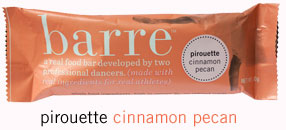
barre barI am not downing dancer industry I quite like (Irina and Max’s Booties), and dancers do go-to bars for a meal in a bite, but I have my doubts about whether Lara Bars, or any other product, actually provide enough sustenance and protein for dancers, and they are all very high in sugars. They are a snack, so stop treating them like a meal! The last thing I do thinks about bars are even though their ingredients may be wholesome, are they combined, what you need? Why not eat the ingredients clean?  By clean, I mean, 7 walnuts, a half a dozen almonds, a fig, a date, rolled oats, pumpkin seeds, flax seeds, cinnamon, chocolate and agave syrup, when all you really need is one yogurt and a handful of blackberries/blueberries right now, especially if you want to lose weight. A bar of any kind is all these ingredients rolled into one and equals a healthy candy bar. It does the same things, it weighs a lot, it has calories, carbs and fat, but not much protein. and if you want protein why play around? Get protein. Get it straight from the source. Those extra CARBS in that bar are excessive, not slow burning, may not be worked off in one classroom or technique class, and are most likely eaten at a time of day when you do not need that kind of energy-unless you are performing. It’s like dancers who eat nothing but ice cream for the casein protein I suspect. It has sugar! Tons of it and the alternatives to straight ice cream, like sorbet, or Ices, have as much sugar and virtually no protein, so are not healthy. If you want milk drink it, but drink organic because it has loads more (70%) omega-3 fatty acids because they feed them grass and “grass-fed usually means: Cows were meant to eat grass, not grain. But nearly all milk producers, including those that sell 100% Certified Organic, exclusively feed their cows grain. Studies are currently underway on the health benefits of dairy products produced from the milk of grass-fed cows. This much is known: grass-fed dairy products contain an increased amount of CLA (conjugated linoleic acid)”. Nearly six times as much. Is this bad? Decide for yourself http://www.natural-by-nature.com/milk-organic-myth.htm

Eat healthy, but keep in mind that not all information is required to be on labels (for your protection) and in advertising, companies tend to try to sell product on the merits of it, but may omit other details which may be of significance to you. I will not say they lie, but most cannot tell the complete truth or their products would not sell. Sometimes just eating the best foods you can find, cleanly, is the best way to lose weight and eat healthily and you do not have to spend a fortune doing it. It is an elitist concept that “rich” or expensive foods are necessarily better. Sort of like the Emperor’s New Clothes. You can study all of this information later when you have lost the weight and are making decisions based on your new more lovely appearance and attitude. Not all of the facts about health foods are out yet and this is not about agriculture and industry as much as it is about you liking what you see and eat, and being able to afford to maintain an eating habit.

Dancers eat and train, they don’t diet and exercise. This stress, diets, constant vigil, trying to find things to eat that are readily available, rather than what you choose or plan, other exercises, aerobic exercises, can take that extra weight away, whittle it away and expose taut lean muscle of the Gods, alone, is a fallacy. Stress alone adds fat. All that expended energy doing crosstraining to burn fat can wear out your instrument, make you old, make you fat, and make you just plain give up and eat whatever is available. Largely, what you eat determines, chemically, what happens that you cannot see and there is no adequate measure for it, except the mirror, and your physical self, so I tend to advise not looking at scales very often. Anyone who has struggled with issues, like I have, will know it defeats you when you expect to see numbers but you don’t understand them and no amount of starving yourself lowers them. Losing weight and toning depends on diet, activity, genetics, body chemistry and desire/discipline but the scale can be a friend, eventually. I have lost more weight not dieting than all of the conscious efforts of someone who watches their weight. I use the scale now (when I diet) to check one aspect of the process, but completely ignoring it can provide better benefits to some people and less stress until you are communicating with your body intelligently and that means listening to it. It is like Google translate-the scale understands the weight, but the context of the conversation is lost in translation! It is the right diet that is important and staying on it until you begin to see results, the right diet of food! Eating enough, not less of the right things, and more caloric intake, rather than less is usually necessary, and which is ultimately important, should increase the more or harder you work. How many hours per week/day do you exercise? How many times do you nourish your body per day? What time do you slow down? Stop eating carbs? What kinds of slow-burning carbs are you eating and when? Protein? And do you allow yourself rewards or cheats? Do you pick at least 20% of your fats per day? Are they good fats? Do you drink enough water?

while in france

And for most of you, who think French food (or Italian food, or British, or Russian) is healthier, it depends on what you eat and when you eat it. These ingredients, bought on a shopping trip, would reflect the appetite of a cyclist racing across Europe, and not a tiny dancer. Why? You tell me. Even in Fre! nch, I can recognize the word “lard”. Canteloupe is one of nature’s only fruits which contains fast-burning carbs-but it is not a dinner item for a dancer trying to build lean muscle, because carbs should be eaten when we are or are going to be active-and sugars, especially, in the early part of the day, say before 4pm, or earlier. It is not suggested, when dieting, to have them later in the day or to subsist on fruits rather than certain veggies because there is a carb chart of veggies, just as there is for fruits, and variety is important in both, but you just should avoid fruit for weight loss and fat loss because all that sugar does is turn into fat. One reason carb diets work is because you are allowed true fats, butter, oils, whipped cream, fatty meats, in short all of things by nature you should know to avoid, they tell you to eat, because chemically our bodies do not turn fat into fat-we make our own-Out of sugars! But you are to starve your body of healthy foods to lose weight! These items were turned into this meal_

Dinner at farm

Which for many reasons, not alone the time of day eaten, a dancer does not need and should avoid. It is fine for a cross country cyclist, though.

Most people would say dancers are disciplined. Not necessarily. If they are professional, they must learn to be. Many of them possess a lot of incorrect information and subsist on that, starving themselves to eat their favorite things, and eat lots of things that they don’t like “to be healthy.” 1st of all, if you do not like something-take it from me-you will eventually reason yourself out of your diet unless you can find a way to make that food palatable, which usually involves putting something you do like into it anyway, thus ruining (possibly) the good of it. Making your own food is key to enjoying it though, and liking it, and being a lot more healthy.

We tend to argue larger portions of the foods we like balanced (?) by smaller portions of the ones we don’t and announce that we ate healthier. Some people need to completely revise their thinking about food and find good reasons for not eating things that are bad for you. Most of these foods are readily available, everyone else eats them, but like smoking, you have to try not smoking before you can say food tastes better and you should just avoid smoking for the health reasons. It is the same way with soda-I have never liked it, just the occasional small sip is enough to remind me that it is just too sweet, and a lot of times, when you train yourself to eat less sugar, less salt, you find later, when eating something pre-prepared that it is too salty or too sweet.

You have adapted your eating habits and are subsequently requiring less salt and sugar, or other things to satiate you, and the inevitable finickiness thereafter is rewarding to you. When you eat good things, bad things taste, well, bad. You have to try it to see if foods are naturally salty, naturally sweet, or whether butter is truly better than healthy fats, to get used to it. It doesn’t sound palatable necessarily, but some things are actually better when they ARE healthy. Feeling good is also about eating healthy and the more you do it, the better you feel.

For some people, adjustments alone, require that dieting may take longer than one expects-like for me. It takes time, but even small results are immediately noticeable. You may feel better, be more energized, and begin to get in tune with your body. It is pretty easy to get healthy foods anywhere now, and with the whole population going Whole Foods crazy, we forget that some things in cans, in cupboards, and frozen are still healthy. Health foods could put a world of good companies out of business forcing up the price of groceries by fulfilling demand for so-called healthier foods.  Natural foods are a good thing and I have always known when I had too much meat in my diet because I tended to make less and eat less. But this is more psychological than nutritive or fact-based. Our bodies tell us something and we have to learn to listen, but that doesn’t mean we have to be food snobs to be healthy. http://content.time.com/time/covers/0,16641,20121203,00.html

time food snobs

x

Part 1 of Winning the War Against Fat-The Emergent Sylph


//www.googletagmanager.com/ns.html?id=GTM-5DBTHW
(function(w,d,s,l,i){w[l]=w[l]||[];w[l].push({‘gtm.start’:
new Date().getTime(),event:’gtm.js’});var f=d.getElementsByTagName(s)[0],
j=d.createElement(s),dl=l!=’dataLayer’?’&l=’+l:”;j.async=true;j.src=
‘//www.googletagmanager.com/gtm.js?id=’+i+dl;f.parentNode.insertBefore(j,f);
})(window,document,’script’,’dataLayer’,’GTM-5DBTHW’);

Lean muscled bodies Sarah Lamb

Lean-muscled bodies in dance-that is what we have come to expect to see-in the media, at a performance, at competitions, on Instagram, on the Internet, in the movies, on So You Think You Can Dance, in the classroom AND in front of the full-length mirror, at home. Riiip! Stop right there! Not perfect, not seeing what you want to see? Not what others see? You are what you eat, and if you do not see that desired image in the mirror, you might feel somewhat of a failure. You might think that no matter what you do you are not ever going to succeed, improve or be the  image you have in your mind that is perfect-usually. Your body may get in the way of your seeing yourself as the best dancer you can be, and feeling good about yourself inspire confidence. Aside from that, it may have nothing much to do with your ability to dance. Getting the body you want is not the same as not being able to rock a hairstyle, bodies are usually obtainable, believe it or not. But, you might be guilty of projecting someone else’s body onto your own.  If anyone tells you you cannot achieve what you want to, prove them wrong!

You are unique. You have to believe that, but you are also capable of being the best that you can be, and the most healthy and strong dancer you can be. To me, and to a growing number of companies who invest large amounts of money in training, and lose dancers due to injury, this is also very important to succeeding in a professional career in ballet. Posers who do photo shoots might just be that, and it is possible that they are not as good a dancer as you are! A career lasts at least 20 years. What you do now will definitely impact the longevity of your dancing career as well as a competition in 4 months. So, you must make a commitment to eat right for the rest of your life and not just to lose weight, only to gain it back again, up and down and so forth.

Therefore if you are gearing up for the winter and you are a dancer you might want to try this plan:

old fashioned winter menu

NOT! Let me say again NOT!

It speaks of holidays and comfort foods and lots of starch and fat and sugar. But what is wrong with it? You say. “I am a dancer and I burn off calories-that is what I do. Well, for every calorie you burn off, another ten of these above turn into fat while you sleep. It isn’t just the sugar, it’s that all the right foods are there, hidden in gravy, butter, marmalade, cheese, sauces, and taters and other foods which you will have to eye cautiously over the holidays and during the winter, because this is what people eat. Regular people, not dancers!

In front of the mirror at the first self-assessment, any women or teenager might say,”I need to lose weight, maybe 5-10 pounds.” In the real life of any woman, every 10 years that need to “go backwards” goes up by 5 or 10 pounds, after you stop wearing the little tiny black dress, your brother’s jeans (with no butt), after babies, surgery, loss of work, a change of regimen, a more sedentary lifestyle, drastic change of lifestyle, health conditions, anything-you develop a bosom and may be lugging around more “desirable” fat, but it’s still fat and weight and adds numbers to the bathroom scale you can’t fathom. Also, we cook, and when we cook, we taste, we nurture and feed others, and have to shop and you know never to go shopping on an empty stomach. Everything looks good, but one benefit of having Madonna’s personal trainer is the likely aspect that she shops for you, puts it in your fridge and guards you from eating outside of your diet. She also works your butt off. Renee Winhoffer is her name. She is a dancer, too. In her words, “I plan and pack all my foods – and if I’m on tour I work with the hotels and cater ahead for specific foods. I often travel with my box of steamed vegetables and lean protein so I don’t get caught out. If I eat out, I make a special request for a green salad with some grilled fish or chicken and a little olive oil. And any time I have a hunger urge I drink 10 gulps of water and then wait 10 minutes.”  She also states that if you want to see results in a week try not eating before your midday snack to attack the fat stores immediately in the AM. You can read more advice by her and other fitness gurus, here, http://fashion.telegraph.co.uk/article/TMG9785991/Workout-and-diet-secrets-of-top-fitness-coaches.html .

However, I find that in doing research including that article one has to look at whether they tell the whole truth, do the same number of exercise hours per day as any given dancer, the same type of dance and dancing as you, and realize that one article and a few tips does not a meal plan make. There are plenty of questions I would want to ask, more on the technical side. Men differ from women, so I try to look at a diet that is good for women, too.

In reality, it might be fat you need to lose, or weight, most people have some, but it might be that more muscle needs to be developed (and are being) or exposed to best display our body’s assets and we have to give this process TIME and the right nutrients to help it along. We may be long of limb and tall, frail and tiny, or somewhere in between, but we can all be the best we can be. All women can relate to this, not just dancers. We all experience this self-doubt and analyze, and it is especially difficult for anyone, for any reason, in any case, and even those who have heretofore had perfect bodies, so no ones difficulties are less important than anyone else’s, whatever they are.

It is sometimes much later in a women’s life that she just asserts herself and accepts this body as her own, or decides to make it the best she can, when she is finally tired of ignoring it or trying to make it something else, feeling guilt or shame. I blame the media, Instagram, men, and sometimes families for making women feel they are less than perfect, and women for listening to them and not being strong and believing in ourselves. To be honest, ballet dancers must make a decision, and that is whether they have the discipline to eat only enough to maintain their exercise level, turn fat into lean muscle, and strive for the weight level required in partnering. It is not fair to maim your partner because you have to eat a cake. Just have to. For this reason, and for the body-beautiful a ballet dancer must be slim, as slim as is reasonably possible-maybe a bit slimmer than is reasonably possible, and she also has to eat right. Luceat lux vestra! But let your own light shine!


Ballet Photo of the Year!!!! Anna Tikhomirova and Artem Ovcharenko


Photographer: Maria Tikhomirova

Anna Tikhomirova and Artem Ovcharenko.

Laguna Beach, CA 2014 ❤


Anna Tikhomirova and Artem Ovcharenko. Laguna Beach, CA, 2014. Photographer: Maria Tikhomirova

Toledo Ballet – The Longest, Annual, Continually-running Nutcracker in the U.S.


WGTE Public Media: Toledo Ballet – Founding, History & the Nutcracker.

▶ The Nutcracker-Behind the Scenes (w. the CIncinnati Ballet), 1974


Love this video!

▶ The Nutcracker: A Fantasy in the Making – YouTube.

Just About Everywhere You Might Be! The Great Russian Nutcracker-Chicago Next!


Moscow Ballet Great Russian Nutcracker

Birds in Ballet


//www.googletagmanager.com/ns.html?id=GTM-5DBTHW
(function(w,d,s,l,i){w[l]=w[l]||[];w[l].push({‘gtm.start’:
new Date().getTime(),event:’gtm.js’});var f=d.getElementsByTagName(s)[0],
j=d.createElement(s),dl=l!=’dataLayer’?’&l=’+l:”;j.async=true;j.src=
‘//www.googletagmanager.com/gtm.js?id=’+i+dl;f.parentNode.insertBefore(j,f);
})(window,document,’script’,’dataLayer’,’GTM-5DBTHW’);

snowy-owl-flying-across-a-field-in-falling-snow

Right now, it’s drizzling freezing rain outside. You think, “How am I going to survive this?” But, like muscle memory, it all comes back to you, and the cold is refreshing, revitalizing even. Yes, it’s cold, but it’s stimulating. Each day, there is a miracle or a tiny bit of improvement, one way or the other. Life. I watched the birds the other day, some still high in the trees, singing to each other loudly, and I wonder, “Why are you still here?” Why haven’t they all flown South yet? We are staying warm inside, but one must venture out into the cold, bundled up, breathing through your nose, though it it not that cold yet, it has hit some pretty low temps these past couple of weeks. I am still waiting for the snow to dump on us. I like layering up my clothes and wearing fuzzy mittens. Sometimes these things remind me more than ever of my childhood and my mother’s concern for me freezing my ear and other cartilage. I wonder how the birds do it. Fly South and know exactly where to come back to. If you are starting something new, something difficult, take it very slowly and practice it correctly, until you can do it correctly faster-that is one way to make improvement. Correctly.You should still do eight and work up to 16. Another thing I was thinking about is a la seconde. Pointing your foot or anything else should be like the owl pictured above spreading his wings. I mean why do it if you are not reaching, trying to fly, to get free? When you jump, you should sustain it, like a bird riding on an air current. Practice. There are so many comparisons to birds in ballet.


I remember when my son was very young and I was having a conversation with my mother. She said, “You may have to work very hard to support your son, you know-to get by.” I got by, and that was 28 years ago. I worked a lot of jobs. ” You might have to work two jobs, maybe waitress. I lot of mothers pay the bills by getting two jobs. You are a single mother.” I remember thinking about all of the jobs I had, working in the cafeteria at age 14, a bakery, other menial positions, but I wasn’t even a single mother then-I was supporting my mother who was sick then, and myself, paying for everything this way. Especially ballet. Ballet was the inspiration, what kept me behind the counter, so to speak. Dancing and thoughts of it, while I worked. Why was she telling me this? As if she had to remind me of my duty? Had anyone ever had to remind me of my duty? Ever? I was born dutiful. I still am. All the years she hadn’t even tried once to work came tumbling down from the shelf where I keep them, battering me. Oddly, now that she is gone, I hardly think of them. She had always said she wanted to be there for me, be a good mother. The books and little pamphlet with drawings in them that she had made to teach me French and Spanish, dancing umbrellas, birthday cats, ballet shoes and ribbons trailing, all passed by.

There was one Summer, after the cafeteria, the one in which I began ballet at Sinclair Community College, where I painted walls in the Alternative School by University of Dayton. Not painted them white or beige, but with colorful and sage advice about the optimism which comes from learning, and choices, about the values of education, to inspire passers by. The then secretary, a middle-aged woman, with one son in parochial school, whom she supported on her own, watched me in the office, tried to teach me things, like the correct ergonomics for typing, and sitting for long periods in a chair, filing, and errand running, and underfoot (probably), she pulled me from this job, and asked me if I could paint a picture for her on the entrance wall outside her office. I painted a field of poppies. Red poppies. Grass shooting up in shades of olive and army and lime.  She liked it. She said it made her happy when she came to work. Dancing and reading made me happy.

The proper way to prepare lettuce is to break it between the fingers, and not cut it-cutting bruises the lettuce. At our library, downtown, was a poem written on the wall in aluminum scroll by Langston Hughes.

“Hold fast to dreams,
For if dreams die
Life is a broken-winged bird,
That cannot fly.”

The bus stop was right across the street and so I stared at this, upon leaving the library, which is kind of the last stop leaving downtown Dayton traveling up Third Street. It’s broken down. Michelin Tire signs, brick factories, greasy spoon the size of a closet, public pay phone. And the library with a garden behind a fence. A pretty garden, a listening area, archive, microfiche machines, bathrooms. Puppet shows. Books. I went right in there and got the poetry book by Langston Hughes and read his poems and drew in my sketchbook I carried around with my dance gear, and other things.  On the way out I stopped and took out cassette tapes of Lifeboat, and jazz. Dayton always had so much potential. Behind the library was Sears. Then over another block or two was Memorial Hall. The Victory Theatre, and the bus. You could transfer from the bus to anywhere. There was this old arcade, which was a several leveled building of shops, like an indoor mall and it had been shut down many years before, and they had renovated it, reopening as a reminder of a bygone era, replete with original railed, an atrium, and stores, Mostly food and little clothes shops for secretaries on their lunch hours. But there was a lot of space for rent. While I was studying Chines with Mrs. Lee (who ran the Chinese restaurant for he daughter), I went next door to the bakery and applied. It was a kosher-Italian bakery which had been in the Jewish neighborhood in North Dayton for many many years and was expanding.I was hired and worked there off an on for a couple of years during high school and once on a break during college. The owner had asked me to stay and manage it, but I had declined, wanting to go back to school. I remember thinking, “Seriously?” I was sophisticated and living in New York, wearing expensive and chic leather boots, lipstick jeans, hair long and very trendy. Long, confident strides. One day, I was walking aimlessly around the shops in the atrium, and I saw an elderly-looking man with a cane. He was graying at the temples, and talking to a friend, sitting there. As I approached, he tried to get my attention. He looked up at me and half-smiled. That gold tooth! Mr. Booker???? Yes!!! My seventh grade social studies teacher a la militant black man. Playing Earth Wind and Fire, writing legal definitions on the chalkboard, allowing me to be a leader on a project about the Space Shuttle. A rebel, a hippie, a man I had looked up to, and one who inspired his students with his passion about equality and freedom. A man who got fired for his “radical” teaching methods. At least we never saw him again. He was friends with Ms. Atkins. A very skinny teacher of English. Very elegant and precise. I wrote a poem in her class about the night, something about envelopes and darkness and light, and riders. She sent it to a competition, and unbeknownst to me, I won. She was taking roll one day and she just dropped the certificate on my desk as she passed, and kept on walking up the aisle.  And Mr. Amos. 7 feet tall, huge afro, long white coat, playing jazz in the ceramic room with the kiln. He did weird art projects, like clay with your eyes closed in 5 minutes, reading about art in magazines and books, using found materials to create sculptures, painting old fired pieces or objects that people had left in classroom from many years before. Forgotten. Make everything in your life about art, about creating, about beauty, about love. And listen to music while doing it. Our detention for talking was to clean out the kiln-room and take home whatever we wanted because he was going to throw it out if we didn’t. This always worked with me, cats, books, whatever I was afraid would be thrown out, or left behind, simply had to come with me. I stayed after school willingly every day, and following some exercise in art, drawing or painting or listening, or reading, came the forage.  And Mr. Booker now looked up at me, with my apron and superior 17 year-old smirk, half aware, and he smiled, and said, “Hello, Ava.” Suddenly, I was me again. The smirk faded and I just stood there, 12, again. Teachers can do that to you. I remember that I about fell over from shock-how could someone age that much in such a short time? Hardship. I did not recognize his former self at first, so aged he seemed from the swaggering, 70’s rock star that had taught us about human rights, but he remembered me. We chatted briefly, he kept looking around, maybe he had had an injury, hence the cane, hence the change. I told him I was going to college, to NYU. He was proud, you could tell, and he congratulated me. We parted. Forever.

Many times there is a phoenix, rising from the ashes. The Firebird, although we never equate the two. But, there has to be ambition and a desire to see oneself as one can be, not necessarily as one is now.

I had gone back to high school, where I took that information, about what I could do, and why dreams were important, and that there was a point to an education, and toughness might be required in order to avoid getting one’s ass kicked and surviving it, if you let it happen, where eventually I graduated. I was driving in the car, with the man from the Dayton Board of Education, who headed a program for at-risk youth, and poor kids from the west side, which though black, did not discriminate against whites. He was the President.  he was an older black man and he had hired me in this program so I could continue my Summer employment. It was to paint houses on the west side of town. I must have grimaced, or made a face. She then went into the anti-snob lecture, you know about my grandpa. He was a working-class contractor. He built half of the country with a firm called Arthur Rabkin (from Cincinnati) during the war, and after. You know the type-black gangster hat (Fedora), Irish mug, piercing blue eyes, leather jacket. He was very handsome and work was his life.  I am an optimistic person. He said he never treated anyone any different, the banker or the bum. He said good morning and raised his hat to both. He said they were the same. One was not any better than the other. One might give himself airs, but he was actually no better.

And then there is Rothbart, half man, half bird of prey. The dark side of ballet, an evil sorcerer, who turns his harem of swans back into princesses at night-how convenient. He is always there, the villain, all-seeing and watching like the raven, looking for an opportunity. I think the villains in ballet are so much more interesting than the noble princes, possibly with the exception of Albrecht, who is a rascal of a man.  All of the birds in ballet. So many real characters to play. So many references in ballet to bird-like qualities. Wings, even when there are no birds, there are fairies. Man’s desire to ascend, a dancer’s desire is to ascend, to transcend. That is theater and art. But art is for everyone, too, not just the wealthy. If companies and schools do not sell all of their ballet tickets, they should reduce the prices for the rest and even give away a good number to the poor and children in school who might not otherwise be able to afford to come! That is good publicity. One never knows where the next birds will come from….

Keep on dancing!


Though currently an app only, this could lead to an excellent form of dance notation!


High-Tech Ballet Shoes Hypnotically Trace The Physical Movement Of Dancers’ Feet.

17 Ballet Icons Who Are Changing The Face Of Dance Today


17 Ballet Icons Who Are Changing The Face Of Dance Today.

Ever Wonder? The Rules and Hazards of Presenting Flowers in Ballet


The Rules and Hazards of Presenting Flowers in Ballet – NYTimes.com.

OH-Ho! Enrollment begins as New York’s American Ballet Theatre opens in Costa Mesa – The Orange County Register


Enrollment begins as New York’s American Ballet Theatre opens in Costa Mesa – The Orange County Register.

Art’s Center for the Performing Arts Ups Ambition-More Cities Need to Have This Verve. It’s Just Good Business.


Reposted

Carmel’s Center for the Performing Arts ups ambition after stemming red ink | 2014-11-08 | Indianapolis Business Journal | IBJ.com.

First Year Fumbles-Rules to Live By, When You are New to the Corps….


During my years as a principal with San Francisco Ballet and Pennsylvania Ballet, it made me cringe if new corps members pulled out their phones to text or tweet. It felt unprofessional in the middle of class, but it was especially disrespectful during rehearsal, even if they weren’t involved in the scene being danced.

Something like checking your phone in the studio may not seem like a big deal, but small mistakes like these add up. If you’re not careful, you could offend other dancers, or worse, send the wrong message to the artistic staff. The transition from star student to new corps member can be difficult to navigate, but don’t start off your first year with an unprofessional impression. Even little things could jeopardize your success.

Mistake 1: Disrespecting Other Dancers
Showing respect for older and higher-ranking dancers begins the minute you walk into the studio. It’s important to give others their space. Skylar Campbell, a second soloist with the National Ballet of Canada, suggests arriving early on your first day and asking a friend, or a friendly-looking colleague, to point out any unclaimed barre spots. Once you get to the center, allow older company members to dance first and wait until the last group to go across the floor.

These unwritten rules don’t mean you can never interact with dancers above your rank. But Campbell says it’s best to feel out the situation and allow them to acknowledge you first. “When older dancers put the hierarchy out of the picture, there’s no problem with being friendly,” he says. It’s okay to go to them for advice, especially when you’re cast, partnering or sharing a role with them. Timing is important, though: Wait for a break or until rehearsal is over to ask for a little guidance. Most dancers will be flattered and more than willing to help, says Campbell. “Don’t let intimidation prevent you from asking questions.”

Mistake 2: Throwing Away Small Roles

Most dancers dread the classic peasant corps roles where they’re stuck in the back of a village scene holding a flower basket. These parts may seem unimportant, but there isn’t a moment when you’re not being watched by the audience, critics or artistic staff. It’s a chance for young dancers to prove their professionalism and artistic maturity. “We all have to put our time in and do some roles that we don’t exactly dream of doing,” says Miami City Ballet soloist Jennifer Lauren. “Give it 100 percent and people will notice.”

Spend as much thought preparing for your role as you would a principal part. Make up a name, background and storyline for your character. Are you on your way to the market to buy apples? Are you going to visit a friend? Invest yourself fully in the part without overacting and distracting from the scene. Know exactly where the audience’s attention should be focused at all times and think of your dancing in terms of the principal’s movement dynamics: If Giselle is having a quiet moment, yours should be even quieter.

Mistake 3: Not Presenting Your Best Self—All Year Long
New company dancers often start the year with a professional look and demeanor. But as the season grinds on and the schedule becomes more grueling, it can be easy to slack on presentation. You don’t have to wear pink tights every day, but dress in a way that flatters your line and reflects thoughtful preparation. Use common sense: If you’re doing a lot of partnering, avoid baggy clothes. If you’re rehearsing Act II of Swan Lake, leave the bell-bottomed legwarmers in your bag.

Making a lasting impression isn’t just about your appearance; it’s also about your mental preparation. For instance, you should take a peek at videos of a work being set—or if it’s a new creation, other works by the choreographer—before rehearsal starts. If you don’t walk into the studio with some background, you’re already behind. Quick learners often get thrown into new roles over those who fumble the steps.

Mistake 4: Slacking Off in Company Class

The way you present yourself in company class sends a strong message about your long-term professionalism and work ethic. Don’t look at class as solely a time to prepare for rehearsal; see it as an opportunity to show your technique and desire to grow. Arrive early to warm up, watch closely as others dance and examine your technical and artistic weaknesses. “It plays a big part in getting noticed,” says Campbell, who adds that young dancers are often frustrated by the lack of attention they get in company class versus feedback they received while training. “A lot of dancers get lost because they don’t rely on self-motivation to further their career.” A mature attitude signals to directors that you’re ready to take on more work, says Lauren. “You can go months without anything being said to you, no compliments or corrections. But they’re always watching.”


Beware of Social Media
It’s tempting to share everything about your new dance job with the social media world. But unless the company has specifically asked you to take pictures, tweet or post status updates, talking about work online can cause tension with your coworkers and directors—or it could get you fired. Many companies, like New York City Ballet, have adopted social media policies that prevent dancers from sharing the health of their colleagues or posting pictures of company events without permission. When in doubt, follow the guidelines your company has set.”

Reposted from-Pointe magazine – Ballet at its Best..

Honesty To All: Beauty and Other Secrets of a World-Famous Principal Ballerina


What do your workouts consist of?Recently, instead of doing traditional stretches or warm-up exercises, I’ve been doing a special kind of gymnastics [“Improvisation Technologies”], originally developed for the dancers of William Forsythe’s company, which helps with balance. Besides that, it has a strengthening effect on your muscles. Even though during rehearsals, we try to exercise both legs, while dancing, the load is never distributed evenly. Therefore the bodies of ballet dancers have various “professional deformations.” So, what we need is not fitness but balancing gymnastics that helps the dancers prepare their bodies for a professional classic ballet rehearsal. This kind of balance can be found in Pilates, Gyrotonics, the gymnastics I mentioned earlier, or vinyasa yoga, which I’ve done in the past.

via The Beauty Secrets of a World-Famous Principal Ballerina.

Move over Ballet Les Trockadero of Monte Carlo: A Star is Born (Comedy avec Vladimir Malakov and Sylvie Guillem)


Malakhov in Sylvie Guillem parody – 1997 — WITH A SURPRISE VISITOR!! – YouTube.